
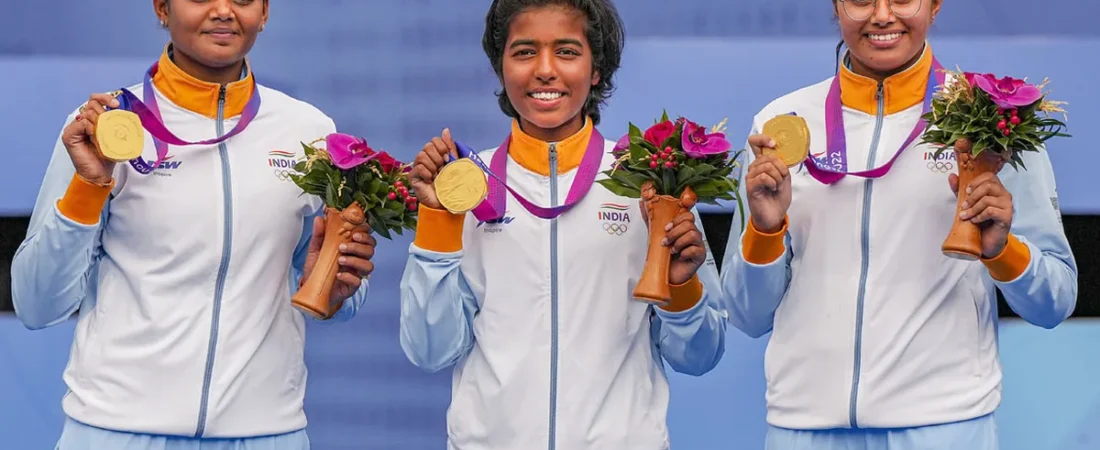
There are days at a multi-sport Games when a country does not just win medals, it redraws the map of a sport. September 30 in Aichi was that kind of day for India. The Asian Games 2026 archery gold story was not one final, or two. It was three finals, three gold medals, and a clean sweep of every compound team title on offer — women’s team, mixed team, and men’s team — all claimed in a single afternoon that moved from controlled brilliance to a shoot-off that will be talked about until Los Angeles 2028.
By the time the light faded over the Okazaki Chuo Sogo Park Multipurpose Square, India had done something that explains why compound archery in Asia now runs through Indian lanes. Jyothi Surekha Vennam, Chikitha Taniparthi and Prithika Pradeep had defended the women’s title with a world-record-equalling 238. Chikitha had returned with Sahil Jadhav to beat South Korea in a shoot-off and lock India’s place in Olympic history. Kushal Dalal, Sahil Jadhav and Ganesh Mani Ratnam Thirumuru had then held their nerve by a single point against China to make it three out of three. Two archers — Chikitha and Sahil — walked away with two gold medals each in one day. This is how it happened, and why it matters far beyond one Wednesday in Japan.
Asian Games 2026 archery gold begins with a world-record statement
The day began with a final that felt, in hindsight, like a warning to everyone else. India’s women’s compound team — Jyothi Surekha Vennam, Chikitha Taniparthi and Prithika Pradeep — faced China for gold and produced a performance that blended experience, youth and the kind of calm that only comes from having defended a title before. The final score, 238-234, tells only half the story. The number that matters is 238 itself: out of a maximum 240 across 24 arrows, India dropped just two points, equalling the world record for a women’s compound team match.
Jyothi and Prithika were flawless, hitting 10s with all eight of their arrows. That level of precision is not normal even at elite level. Compound archery rewards repeatability — the same draw, the same anchor, the same release, under wind, noise and consequence — and the Indian trio turned the final into a demonstration. Two ends of 60-58 gave India early control, and when China tried to press in the closing arrows, the response was six consecutive 10s to finish. Champions often win finals; great teams close them without giving the opponent a single loose arrow to chase.
Experience at the anchor point
Jyothi Surekha Vennam has been the constant through India’s compound rise, a member of the Hangzhou gold-winning team and one of the most decorated archers the country has produced. Her presence matters in ways a scoresheet cannot show. In a team final, shooting order and rhythm are everything. A senior archer who never rushes, never shows panic after a nine, and trusts the process shot after shot sets the temperature for the whole line. That is what Jyothi brings, and on September 30 it allowed two younger teammates to shoot freely around her.
The system behind the score
A 238 does not happen because three archers have a good day. It happens because a system keeps producing archers who can shoot 10s when a final is on the line. Prithika Pradeep said afterwards that even after a nine, the message in the team was to get back to what they knew best. That is coaching and depth compressed into one sentence. India did not stumble into this Asian Games 2026 archery gold; they arrived with a production line and proved it against the best in Asia.
Asian Games 2026 archery gold and the shoot-off that changed Olympic history
If the women’s final was a statement, the mixed team final was a thriller with an Olympic subplot. Chikitha Taniparthi walked back onto the line alongside Sahil Jadhav, facing South Korea’s Park Jungyoon and Choi Eun Gyu. The match finished level at 157-157 after regular play. Everything — the gold medal, the title defence, and a quota place for the Los Angeles 2028 Olympics — came down to a shoot-off.
Shoot-offs are sport at its most exposed. Both Indian archers struck 10s. Park Jungyoon answered with a 10, but Choi Eun Gyu could only find a nine. India took the shoot-off 10-9 and, with gold, something no Asian Games archery final has carried before: qualification for the compound mixed team at LA 2028, where the discipline makes its Olympic debut. India became the first country to qualify for that event — by winning a shoot-off against South Korea, the traditional superpower of target archery.
Why the shoot-off mattered more than the medal
Asian Games gold medals are precious, but Olympic quota places change programmes. For decades, compound archery lived outside the Olympic tent, dominant at World Cups and Asian Games but invisible on the biggest stage. LA 2028 changes that, with the compound mixed team entering the Olympic programme. Federations everywhere are now building towards Los Angeles, yet India has already secured its seat at the table. That head start shapes selection trials, funding conversations and the psychological balance of the next two seasons. Every pair that lines up against Chikitha and Sahil between now and 2028 knows they are chasing a team that has already qualified — and already won under the exact pressure an Olympic final will bring.
A title defended the hard way
It is worth remembering that this was also a title defence. India had won the compound mixed team crown at Hangzhou, and the road back to the final in Aichi was not smooth. The semi-final against Thailand finished 156-155, a one-point escape that could easily have ended the campaign. Champions are often defined less by their best match than by the tight one they survive on the way. India survived Thailand by a point, then beat Korea in a shoot-off. That is not luck. That is a team whose floor is high enough to win even when the arrows are not perfect.
The Men’s Final That Completed the Clean Sweep
Two golds would have made September 30 a famous day. The men’s team turned it into a historic one. Kushal Dalal, Sahil Jadhav and Ganesh Mani Ratnam Thirumuru faced China in the final with the chance to complete a sweep no Indian archery contingent had ever managed at an Asian Games: all three compound team titles at a single edition. The margin could hardly have been finer. India won 238-237.
One point. In a 24-arrow match, one point is a single arrow landing a ring further out — a breath of wind, a release a fraction early, a sight picture held a heartbeat too long. The men’s final was the opposite of the women’s in character. Where Jyothi’s team controlled their final from the front, the men had to absorb pressure and answer China arrow for arrow. That they produced 238 themselves, one point below the women’s world-record-equalling mark and enough by the slimmest margin, says everything about the depth India now carries in compound archery. Three different finals, three different kinds of contest — a controlled defence, a shoot-off, and a one-point dogfight — and India won all of them.
Sahil Jadhav’s extraordinary afternoon
Sahil Jadhav shot in two of the three finals, and his day deserves its own place in this story. First the mixed team shoot-off against Korea, with an Olympic quota hanging on his arrows. Then back out with the men’s team for a 238-237 win over China. Shooting multiple high-stakes matches in a day is a specific skill: the body cools down, the mind replays the last final, and the next opponent is already studying you. Sahil’s ability to reset and deliver again is the kind of trait coaches cannot drill in a month. It is built over seasons, and it is why India’s compound programme keeps winning finals that other teams find ways to lose.
Two Golds in One Day: The Chikitha-Sahil Axis
Every golden day has faces, and September 30 belonged to two young archers. Chikitha Taniparthi won the women’s team gold in the morning and the mixed team gold hours later. Sahil Jadhav won the mixed title and then the men’s. Between them, they were involved in every gold medal India won that day. Clean sweeps are team achievements, but they are powered by individuals who can carry form across matches, formats and partners.
Chikitha’s day is particularly striking because of what it signals for the future. She shot alongside Jyothi, the established great, and matched the standard. She then partnered Sahil and held her nerve in a shoot-off with Olympic qualification on the line. Archery careers are long, and peaks can last a decade, but breakthrough days like this rearrange a pecking order. India no longer depends on one star in compound archery. The baton is being shared, and on the evidence of Aichi, the younger hands are just as steady.
There is a useful comparison elsewhere in India’s Aichi campaign. On the athletics track, India’s story has also been about seizing moments when the favourite is absent or the door opens a crack — as in the men’s javelin final, where India took silver and bronze — while endurance history was rewritten when Sawan Barwal’s national-record marathon silver ended a 44-year wait. The archery clean sweep belongs in that same conversation: an Indian contingent learning, sport by sport, how to convert pressure days into defining ones.
What the LA 2028 Quota Really Means
To understand the size of what Chikitha and Sahil achieved, it helps to understand what an Olympic quota does to a sport back home. Compound archery has thrived in India’s medal economy — dependable at Asian Games and World Cups — but Olympic absence has always capped its funding, visibility and pull on young talent. Parents steering children towards sport notice which disciplines appear on television every four years. Sponsors notice too.
A first-mover advantage
Being the first country to qualify for the compound mixed team at LA 2028 gives India a two-year runway that rivals must earn later. Selection can be planned rather than gambled. The pair, or the pool around them, can be tested at World Cups with Los Angeles in mind. Sports Authority and federation planning can target a known event instead of a hypothetical one. None of that guarantees an Olympic medal — the field in Los Angeles will be ferocious, and Korea, the United States and Europe’s compound powers will arrive prepared — but India has removed the first and most dangerous hurdle: not being there at all. For full coverage of the mixed team’s Olympic breakthrough, Olympics.com’s report on India’s clean sweep and quota tracks how the day unfolded, while Mint’s live Asian Games coverage followed the shoot-off as it happened.
The Jyothi question
Jyothi Surekha Vennam has carried Indian compound archery for years without an Olympic stage to aim at. LA 2028 offers only the mixed team, so veterans and newcomers alike must earn one of two places. Selection over the next two years will be ruthless — and September 30 proved India has more than one pair capable of winning a shoot-off when everything is on the line.
October 1 and the Next Chapter
Sport does not let golden days sit still. On October 1, Chikitha Taniparthi returned for the individual event and lost a tight quarterfinal 143-144 to Indonesia’s Nurisa Dian Ashrifah. A one-point defeat, a day after two gold medals. It would be easy to frame that as a comedown; it is better understood as the rhythm of elite archery. Individual matches are coin-flips at this level, decided by one arrow across fifteen, and even the best archer in the world loses them.
The honest reading is that October 1 changes nothing about September 30 while pointing to what comes next. Chikitha now knows she can win team finals and shoot-offs. The individual crown at a major Games is the obvious next chapter, and a 143 in a quarterfinal loss shows she is already shooting scores that contend. India’s compound story at these Games was always going to be led by the team sweep — three finals, three wins, a first-ever full house — with the individual events adding texture rather than rewriting the headline. The Asian Games 2026 archery gold sweep remains the definitive Indian archery performance of this era, whatever the individual brackets decided later in the week.
Why India Owns Compound Archery Right Now
Step back and the pattern is clear. India defended the women’s title with a world-record-equalling score, defended the mixed title in a shoot-off, and added the men’s title by a single point. Three teams, mixing Hangzhou veterans with newcomers shooting career-defining arrows, all delivered on the same afternoon. That is not a hot streak. That is a system reaching maturity.
The rest of India’s Asian Games campaign will produce its own heroes, and the medal table will move again before the closing ceremony. But some days are remembered because they change what a country believes is possible in a sport. September 30, 2026 is one of those days for Indian archery. The targets will be packed away, the compound team will fly home, and the countdown to Los Angeles — an Olympics where Indian compound archers will finally stand on the line — is already running. After Aichi, nobody will be surprised by anything this team does next. That, more than any single score, is what a clean sweep buys you.
Why this story matters: Three finals, three gold medals and a world-record-equalling score made India’s compound archers the story of Aichi — and by winning the shoot-off that secured the first LA 2028 quota in Olympic compound history, Chikitha Taniparthi and Sahil Jadhav carried Indian archery onto a stage it has waited decades to reach.