
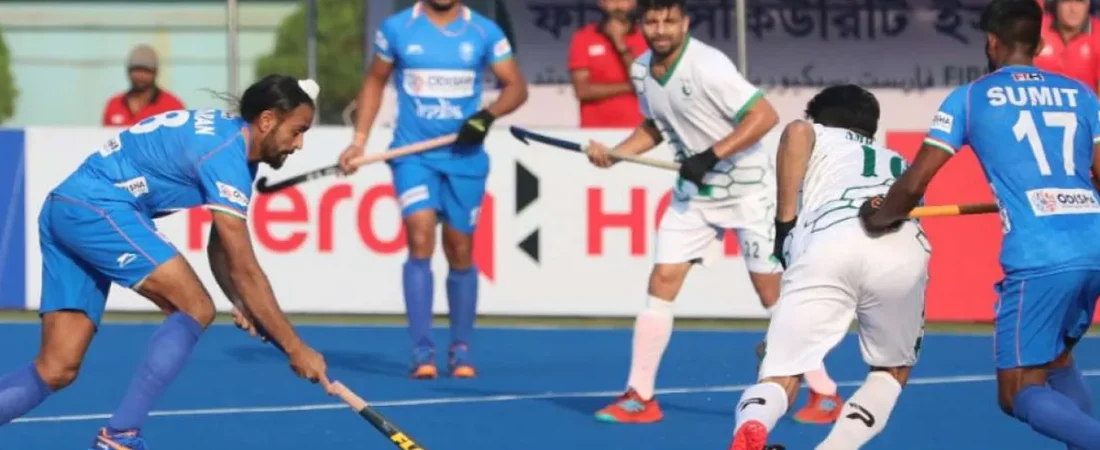
The most storied rivalry in Asian hockey is back on the biggest stage the continent offers. The India vs Pakistan hockey semifinal at the Asian Games 2026 takes place on Thursday, October 1, at the Gifu Prefectural Green Stadium in Kakamigahara, Japan, and it carries far more than a place in the final. India arrive as defending champions with a perfect record; Pakistan arrive as the wounded giants of Asian hockey, desperate to restore a legacy that has faded but never died. One match, one afternoon, and a lifetime of history in the balance.
Table of Contents
- Match details: date, time, venue and how to watch
- India vs Pakistan hockey semifinal: what is at stake
- Head-to-head: a rivalry written in history
- India’s road to the semifinal
- The Pakistan threat: underdogs with nothing to lose
- Key players to watch
- India vs Pakistan hockey semifinal prediction
Match details: date, time, venue and how to watch
Everything you need to know before the first whistle:
| Match | India vs Pakistan, Men’s Hockey Semifinal, Asian Games 2026 |
| Date | Thursday, October 1, 2026 |
| Time | 1:00 PM IST (4:30 PM JST local) |
| Venue | Gifu Prefectural Green Stadium, Kakamigahara, Japan |
| TV (India) | Sony Sports Network (Ten 3, Ten 4, Ten 5), DD Sports |
| Live streaming (India) | SonyLIV app and website |
| Winner plays | Final on October 3 vs the winner of Malaysia vs South Korea |
Reports also indicate that midfielder Rajkumar Pal has been ruled out of the semifinal, which would be a selection headache for India in the middle of the park — though as ever with this fixture, the XI matters less than the mood. Hockey fans in India can follow the India vs Pakistan hockey semifinal live on SonyLIV from 1:00 PM IST, with television coverage across the Sony Sports Network channels and DD Sports.
India vs Pakistan hockey semifinal: what is at stake
A place in the Asian Games final is only the beginning. The winner of this semifinal advances to Saturday’s gold medal match against either Malaysia or South Korea — but there is a prize far bigger than Asiad gold attached to this tournament. The Asian Games champion earns a direct qualification berth for the LA 2028 Olympics, sparing the winner the grind of Olympic qualifiers. For two nations whose Olympic histories are woven into their national identities, that shortcut to Los Angeles turns an already feverish semifinal into something close to a war of attrition.
India know this road well. They walked it in Hangzhou three years ago, winning gold and booking their Paris ticket early. Pakistan, by contrast, are chasing redemption on multiple fronts: a first Asiad final in years, a shot at the Olympic berth that has eluded them, and a chance to prove that the most decorated hockey nation in Asian Games history still belongs at the top table.
The Olympic shortcut
Direct qualification matters more than it might sound. The Olympic qualifying tournaments are brutal, congested affairs where one bad quarter can end a four-year cycle. Winning in Kakamigahara removes that risk entirely. It is why both camps have treated this tournament with a seriousness that goes beyond the medal — and why Thursday’s semifinal will be played with the intensity of a final.
Defending champions vs fallen giants
India are the holders, unbeaten and utterly dominant through the pool stage. Pakistan finished as Pool B runners-up, solid rather than spectacular, and this is the first time the two sides have met at these Games. The script is familiar; the ending, history says, is not always written in advance.
Head-to-head: a rivalry written in history
No fixture in world hockey carries the emotional weight of India versus Pakistan. Together, the two nations account for eleven Olympic gold medals, and for decades the Asian Games final was practically reserved for them. The recent chapter of the rivalry, though, has been one-sided — and brutally so.
At the Hangzhou Asian Games in 2023, India demolished Pakistan 10-2 in the pool stage, the heaviest defeat Pakistan have ever suffered against India. That scoreline has hung over every meeting since. It was not merely a loss; it was a statement about the divergent paths of the two programmes — India’s professional, science-backed resurgence against Pakistan’s struggle with funding, infrastructure and administrative chaos.
Yet Pakistan’s players carry a different memory too: they remain the most successful team in Asian Games hockey history, with eight gold medals. The green shirts may be underdogs now, but the badge still weighs something. As coverage of the build-up has noted, Pakistan’s squad believes one big afternoon can rewrite years of narrative — and there is no bigger afternoon than this one.
The last meeting that still stings
The 10-2 in Hangzhou is the reference point both dressing rooms will acknowledge this week. India’s players will draw confidence from it; Pakistan’s will draw fuel. Semifinals, however, have a habit of compressing form into fifty-odd minutes of nerves. India have been warned, publicly and privately, that knockout hockey against Pakistan is a different animal from pool hockey against anyone.
India’s road to the semifinal
If momentum wins trophies, India should already be polishing the gold. Harmanpreet Singh’s side won all five of their Pool A matches, topping the group with a scarcely believable goal difference of +45:
- India 13-1 Indonesia — a statement of intent to open the campaign
- India 16-1 Sri Lanka — the biggest rout of the group stage
- India 8-2 South Korea — the first real test, passed with something to spare
- India 2-0 Japan — a controlled, professional win over the hosts
- India 10-0 Bangladesh — Harmanpreet’s hat-trick and two goals from Shilanand Lakra sealing top spot
Forty-nine goals scored, four conceded. The numbers are absurd, but they flatter and warn in equal measure. India have barely been stretched; their only close game, the 2-0 against Japan, was also their most impressive, a display of defensive discipline and game management that pool-stage blowouts rarely demand. The drag-flick battery has fired, the forwards have rotated freely, and the defence has had long, quiet afternoons.
The reported absence of Rajkumar Pal, if confirmed, removes a key link man from India’s midfield rotation. Against Pakistan’s counter-attacking pace, that could matter more than any of the pool-stage numbers.
Form guide: five games, five wins
India’s +45 goal difference is the best of the tournament, and their defensive record — four goals conceded in five matches — is its equal. Craig Fulton’s side press high, counter-press in packs, and treat penalty corners like penalties. Harmanpreet’s hat-trick against Bangladesh was a reminder that the world’s most feared drag-flicker remains, at his best, close to unstoppable.
The Pakistan threat: underdogs with nothing to lose
Write Pakistan off at your peril — not because of their recent record, which offers little comfort, but because of what this fixture does to them. Pakistan finished as Pool B runners-up, efficient enough without ever suggesting they belong in the same bracket as India’s machine. And yet, the history of this rivalry is a museum of ambushes.
Pakistan’s game plan is no secret: sit compact, defend the circle in numbers, and strike on the counter through their quick forwards. They will happily concede possession and territory. Their danger lives in transition — two or three passes, a deflection at the far post, and suddenly the favourites are chasing a semifinal they were supposed to stroll.
Why knockout hockey suits Pakistan
Favourites carry expectations; underdogs carry only opportunity. Pakistan’s players have spoken all week about having nothing to lose, and in a one-off semifinal that is a genuinely dangerous mindset. If they score first, the psychology of the match inverts: India, unbeaten and untested, would face their first moment of real adversity in the entire tournament — against the one opponent they least want to gift belief to.
Key players to watch
Harmanpreet Singh (India)
The captain, the drag-flick king, the heartbeat of this team. Harmanpreet’s hat-trick in the final pool game against Bangladesh took his tournament tally into double figures and underlined India’s deadliest weapon: the penalty corner. Pakistan will defend corners desperately, knowing that every award inside their half is close to a coin-flip goal. If Harmanpreet’s flicks find their range early, the semifinal could be settled by half-time.
Shilanand Lakra (India)
The forward has been one of the stories of India’s campaign, scoring twice against Bangladesh and troubling every defence he has faced with his movement across the front line. In a match likely to be decided by half-chances in a crowded circle, Lakra’s anticipation could be India’s quiet difference-maker.
Pakistan’s counter-attacking forwards
Pakistan’s route to an upset runs through their pace on the break. Their forwards will spend long stretches starved of the ball, asked to defend from the front and then explode into the spaces India’s attacking full-backs leave behind. One clean counter, finished clinically, changes everything.
The tactical battle
Beneath the emotion sits a fascinating tactical contest. India want the game played at their tempo: high press, quick ball circulation, waves of circle entries and a steady diet of penalty corners. Their structure under Craig Fulton is built on control — a deep-lying playmaker knitting play together, full-backs stepping into midfield, and forwards rotating positions to drag markers out of shape. When India establish that rhythm, as they did against Japan in a mature 2-0 win, they are extraordinarily hard to break down.
Pakistan’s counter-plan is to break the rhythm rather than match it. Expect a compact defensive block, a low press that only springs near halfway, and immediate vertical passes when possession turns over. Every free hit, every sideline ball becomes an attempt to slow India’s momentum and fragment the game into the kind of scrappy, stop-start contest where one deflection, one umpiring call, one moment of madness decides everything. Pakistan do not need to be better for sixty minutes. They need to be better for sixty seconds.
The penalty-corner battle may be where the semifinal is truly decided. India’s conversion rate, powered by Harmanpreet and a battery of variations behind him, has been the tournament’s most reliable scoring mechanism. Pakistan’s corner defence — first runner charging, goalkeeper organising — will be rehearsed to exhaustion in the build-up. If Pakistan survive India’s corner onslaught in the first two quarters, belief will grow with every minute. If they concede twice early to the flick, the game plan collapses into chasing shadows.
Pressure, and who carries it better
There is also the small matter of expectation. India have not merely won their matches at these Games; they have annihilated opponents, and a nation of a billion and a half has already pencilled in the gold medal. That weight is real. Pakistan, meanwhile, will take the field at the Gifu Prefectural Green Stadium with the strange freedom of a team nobody expects to win, in a stadium where every neutral will be quietly hoping for an upset. Semifinals between these two nations have turned on exactly this psychological asymmetry before.
India vs Pakistan hockey semifinal prediction
Prediction (not a result — the match is yet to be played): India start as overwhelming favourites, and rightly so. Five wins from five, a +45 goal difference, the tournament’s most potent penalty-corner unit and the confidence of defending champions make Craig Fulton’s side the team to beat. Our prediction is an India win by a two or three-goal margin — something in the region of 4-1 or 4-2 — with Harmanpreet Singh on the scoresheet from a penalty corner.
But predictions in this fixture come with a health warning. Pakistan’s only realistic path — an early goal, a packed circle, a goalkeeper playing the game of his life — is also the oldest script in the rivalry. If India score first and early, the floodgates may open as they did in Hangzhou. If it is still level deep into the second half, Kakamigahara could witness one of the great Asian Games ambushes.
Either way, do not miss it. The winner meets Malaysia or South Korea in Saturday’s final, with an LA 2028 Olympic berth awaiting the champion. And whatever happens on Thursday, India’s golden Asian Games has already delivered stories across sports — from the kabaddi double gold against Iran to Sawan Barwal’s national-record marathon silver. A hockey final would be the biggest of them all.
Why this story matters: Because India vs Pakistan in hockey is never just a match — it is a century of shared history, eleven Olympic golds and national pride compressed into one afternoon in Kakamigahara, with a ticket to the LA 2028 Olympics riding on the result. The India vs Pakistan hockey semifinal is the fixture that stops two nations, and on Thursday it decides who marches toward Los Angeles.