
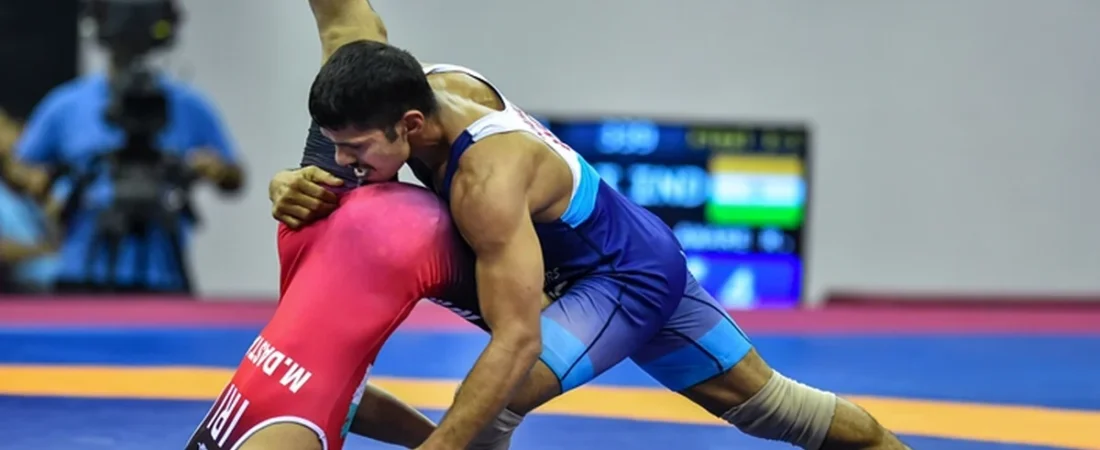
Some wins are counted. Others are felt. The Sujeet Kalkal wrestling gold at the Asian Games 2026 belongs firmly to the second category, because for two minutes it was not a victory at all — it was a defeat happening in public, a 65kg freestyle final slipping away at 2-9 with less than two minutes left on the clock. What followed was one of the most dramatic finishes of the entire Games: a storm of attacks and takedowns, eight straight points, and a decisive final takedown with only seconds remaining that flipped the scoreboard to 10-9 and gave India its first wrestling gold of Aichi-Nagoya — and its 14th gold medal overall.
The Sujeet Kalkal wrestling gold mattered for more than the tally. Wrestling had been quieter than India hoped all week, an unfamiliar silence on the mat that is traditionally India’s most productive Asian Games sport. One bout changed the noise. This is the story of the comeback, the context around it, and why a single 10-9 final may be remembered as the moment India’s wrestling campaign finally roared back to life.
Sujeet Kalkal Wrestling Gold: The Bout in Full
Freestyle finals at the Asian Games are rarely casual affairs, but the 65kg gold-medal bout between Sujeet Kalkal and Tajikistan’s Abdulmazhid Kudiev had an extra edge from the first whistle. Kudiev is a class operator at this weight, and he wrestled the opening exchanges like a man who knew exactly how to bank a lead: probing ties, quick level changes, and the kind of clinical finishing that punishes even half-mistakes. By the time the bout reached its late stages, the scoreboard read 9-2 in the Tajik’s favour, and with less than two minutes remaining, the Indian corner was staring at a silver.
What separates good wrestlers from great ones is not technique alone — at this level, everyone has technique. It is what made the Sujeet Kalkal wrestling gold possible in the first place. Kalkal kept attacking. The transformation of the final minute and a half was sudden and total: a series of attacks and takedowns that turned a controlled 2-9 deficit into a frantic, roaring pursuit, eight straight points scored late in the bout, and then — with only seconds remaining — the decisive final takedown that gave him the lead he would never surrender. 10-9. Gold.
The Deciding Seconds
Ask any wrestler what the last thirty seconds of a final feel like and you will hear some version of the same answer: time becomes elastic, noise disappears, and everything narrows to grips, hips and breath. Kalkal needed points and he needed them immediately, which meant he needed to take risks — and in freestyle wrestling, the risks you take when you are behind are exactly the openings your opponent is waiting for.
That is what makes the Sujeet Kalkal wrestling gold so remarkable. He attacked without conceding. The eight straight points did not come from one lucky throw; they came from a relentless sequence of offensive wrestling, each takedown forcing Kudiev further onto the defensive, each score raising the volume in the hall. By the time the final takedown landed with only seconds remaining, the bout had been completely inverted — and the clock, finally, was on India’s side.
The Comeback: Eight Points in Under Two Minutes
To understand the scale of what happened in Aichi, consider what a 2-9 deficit actually means in freestyle wrestling. Nine points is not a stumble; it is a rout in progress. In most bouts, a wrestler trailing by seven with two minutes left is managing the damage, protecting the scoreline, and accepting the inevitable. Kalkal did the opposite. He wrestled the final two minutes as though the score were tied.
The arithmetic of the comeback is worth spelling out. Eight straight points in under two minutes means scoring roughly every fifteen seconds, and it means scoring while exposed — because every attack you launch with the clock dying is an attack your opponent can counter. The Sujeet Kalkal wrestling gold was not won by caution. It was won by a wrestler who decided that a certain silver was worth gambling for an unlikely gold.
2-9 Down: The Moment of Choice
Every comeback has a pivot point, the instant where the wrestler either folds or finds something extra. At 2-9 with less than two minutes remaining, Kalkal’s pivot was unmistakable. The defensive posture of the middle of the bout disappeared. The level changes came faster. The grip fighting became more urgent. And crucially, the attacks started landing — takedowns that had been defended earlier suddenly found their mark, because Kudiev, sensing the gold, was beginning to wrestle not to lose.
There is a well-worn truth in combat sports: the hardest lead to hold is the one you think you have already won. Kudiev’s 2-9 advantage was real, but it was also the kind of advantage that invites a wrestler to coast, to trade space for time, to defend rather than attack. Kalkal exploited exactly that shift, and the eight-point run that followed was as much a product of pressure as of technique.
The Final Takedown
The decisive score arrived with only seconds remaining — a takedown that completed the comeback and sealed the 10-9 victory. Picture it: the score tight, the clock nearly dead, both wrestlers exhausted, and one final explosion of offence deciding everything. When the final whistle blew, the scoreboard showed Sujeet Kalkal 10, Abdulmazhid Kudiev 9, and India had its first wrestling gold of the Games.
Finishes like the Sujeet Kalkal wrestling gold enter a sport’s folklore quickly. Years from now, Indian wrestling fans will remember where they were when Kalkal completed his comeback from 2-9 down. The Sujeet Kalkal wrestling gold will be replayed, retold and re-lived — because comebacks of this size, sealed with seconds remaining, are what make people fall in love with sport in the first place.
Who Is Sujeet Kalkal
The 65kg freestyle division is one of the deepest weight classes in Asian wrestling, and gold there is never an accident. Kalkal’s run to the final at Aichi-Nagoya had already announced him as a serious contender, but the final against Kudiev was the bout that will define him — the night he refused to lose a match he had already lost on paper.
Beyond the medals and the scoreline, the Sujeet Kalkal wrestling gold revealed something more important: temperament. Wrestling is a sport of small margins and large emotions, and the wrestlers who thrive in it are the ones whose decision-making survives pressure. Trailing 2-9, Kalkal’s decisions got better, not worse. His shot selection sharpened. His finishes became cleaner. His urgency stayed controlled rather than frantic. That is championship temperament, and it is rarer than championship technique.
The Sujeet Kalkal wrestling gold also arrives at a significant moment for Indian freestyle wrestling. The 65kg class has been a marquee Indian weight for years, and a new champion stepping up at the Asian Games — in a final, against a top Tajik opponent, from a near-impossible position — signals that the pipeline at this weight remains strong. Whatever comes next in Kalkal’s career, he will always be the wrestler who turned 2-9 into 10-9 when it mattered most.
Why This Gold Mattered for Indian Wrestling
Context is everything in multi-sport Games, and the context of the Sujeet Kalkal wrestling gold is what elevates it from a great bout to a landmark moment. Before Kalkal stepped onto the mat, wrestling — traditionally India’s most productive Asian Games sport — had been quieter than the country hoped. The medals were coming, but the golds were not. For a sport that India expects to deliver champions, that silence was becoming uncomfortable.
Kalkal broke the silence in the loudest possible way. This was India’s first wrestling gold at the 2026 Asian Games, and it landed at exactly the moment the contingent needed it: late in the Games, with the medal tally surging, and with wrestling — of all sports — finally contributing a champion. One bout did not just add a gold to the table. It rebalanced the story of India’s entire wrestling campaign.
A Fortress Sport Finally Delivers
India’s golds at Aichi-Nagoya have come overwhelmingly from what might be called fortress sports — disciplines with deep systems, professional leagues, international exposure and a culture of winning finals. Kabaddi delivered a double gold against Iran, as our report on India’s kabaddi double gold at the Asian Games detailed. Archery swept all three compound team titles. Women’s cricket struck gold. Wrestling, historically the most reliable of them all, had been the conspicuous absence — until Kalkal.
The Sujeet Kalkal wrestling gold therefore reads as a restoration. Wrestling belongs in India’s gold column at the Asian Games. It is where the sport has lived for generations, and Kalkal’s comeback ensured it would not be left out of the Aichi-Nagoya story. Fortress sports win finals; on the night it mattered, India’s wrestler did exactly that.
A Quiet Week on the Mat: Nitesh’s Silver, Sunil’s Bronze
To appreciate the Sujeet Kalkal wrestling gold fully, you have to understand the week that preceded it. The mat had not been barren — far from it. Nitesh Siwach took a historic silver in the Greco-Roman 97kg division, losing the gold-medal bout to Japan’s Yuri Nakazato on October 1. A silver in Greco-Roman at this level is a genuine achievement, and it was reported as a historic result for India in the classical style.
Sunil Kumar added a Greco-Roman 87kg bronze, defeating the Philippines’ Callum Roberts to reach the podium. Both results mattered. Both were celebrated. But neither was the gold that Indian wrestling, by its own standards, expects to produce at the Asian Games — and the longer the gold stayed missing, the more the conversation around the wrestling contingent tightened.
Silver Is Not Failure — But Gold Is the Standard
It is worth saying clearly, as our analysis of India’s medal tally argued at the 60-medal mark: silver is not failure. Nitesh Siwach standing second in Asia at 97kg Greco-Roman is an outstanding result, and Sunil Kumar’s bronze is a podium at the continent’s biggest multi-sport event. Every one of those medals was earned the hard way.
But wrestling in India measures itself differently. This is the sport that has carried Indian hopes at Olympics and Asian Games for decades, the sport whose champions are household names, the sport where gold is the expectation rather than the surprise. That is why the Sujeet Kalkal wrestling gold landed with such force: it was not just another medal. It was the medal the wrestling programme had been waiting for all week, delivered in the most dramatic fashion imaginable.
How a 2-9 Deficit Becomes a 10-9 Win
For readers who do not follow wrestling closely, the mechanics of Kalkal’s comeback deserve a closer look — because what he did was not just brave, it was technically extraordinary. Freestyle wrestling bouts are contested over two three-minute periods, and points are awarded for takedowns, exposures, reversals and other scoring actions. A takedown — bringing your opponent from standing to the mat under control — is the bread and butter of the sport, worth two points.
At 2-9, Kalkal needed eight points and he needed them without giving any back. That means scoring the equivalent of four clean takedowns, or a combination of takedowns and higher-value scoring actions, while defending perfectly against an opponent who only needed to run the clock. In practice, it means attacking relentlessly while staying defensively airtight — two things that are very hard to do at the same time, especially when exhaustion has set in.
Attacking From Behind: The Tactical Tightrope
The tactical difficulty of a comeback in wrestling is underappreciated. When you are ahead, you can choose your engagements; when you are behind, you must force them. Every forced engagement is an opportunity for your opponent to counter and extend the lead. Kalkal’s eight straight points therefore tell two stories at once: a story of offensive brilliance, and a story of defensive discipline — because at no point during the comeback did Kudiev add to his nine.
The Sujeet Kalkal wrestling gold is also a reminder of why freestyle is such compelling viewing. Unlike sports where a late lead can be protected by possession or territory, wrestling’s scoring system means a bout is genuinely alive until the final whistle. A seven-point lead with two minutes left looks insurmountable. It is not. Kalkal proved it, one takedown at a time, until the decisive final takedown with seconds remaining completed one of the great Asian Games comebacks.
The Sujeet Kalkal Wrestling Gold in India’s Medal Surge
The Sujeet Kalkal wrestling gold was India’s 14th gold of the 2026 Asian Games at the point it was won — and it arrived in the middle of one of the most productive stretches of the entire campaign. As reports of India’s medal tally crossing 75 showed, the contingent was piling up golds across sports in the closing days, and wrestling’s contribution meant the surge was genuinely broad-based rather than concentrated in one or two disciplines.
That breadth matters. As our tally analysis noted, India’s 60-medal position inside the top eight was built on depth across shooting, athletics, archery, kabaddi, cricket, boxing and wrestling — but the gold count is what moves a nation up the standings. Every additional gold from an unexpected or dramatic source, like Kalkal’s comeback, does double duty: it adds to the total and it changes the narrative around the campaign.
Marathon Silver, Wrestling Gold: Two Kinds of History
India’s Aichi-Nagoya campaign has been full of landmark moments in endurance and combat sports alike. Days earlier, Sawan Barwal’s national-record marathon silver ended a 44-year wait on the roads; on the mat, Kalkal ended a week-long wait for a wrestling gold with a comeback for the ages. Different sports, different kinds of history — but the Sujeet Kalkal wrestling gold shares the same theme: Indian athletes finding something extra when the moment demanded it.
The Sujeet Kalkal wrestling gold also fits the pattern of India’s best days at these Games, when medals arrived in clusters and momentum built on itself. A first wrestling gold does not just sit on the tally; it lifts the entire wrestling contingent, validates the coaching setup, and reminds every other Indian athlete still to compete that no deficit — on the scoreboard or in a campaign — is ever truly final.
What Comes Next After Aichi
For Sujeet Kalkal personally, the Sujeet Kalkal wrestling gold changes everything. An Asian Games gold at 65kg, won from 2-9 down against a top Tajik opponent, is the kind of result that reshapes a career’s trajectory — selection, funding, sponsorship, seeding, and the quiet confidence that comes from knowing you have done it on the biggest stage. The comeback will follow him, and that is a good thing: it is a calling card, a story, and a proof of temperament all in one.
The Sujeet Kalkal wrestling gold is both a relief and a challenge for Indian wrestling. The relief is obvious: the sport’s gold drought at these Games is over, and it ended in the most emphatic way possible. The challenge is to ensure that Aichi-Nagoya becomes a foundation rather than an exception — that the systems producing talents like Kalkal, Nitesh Siwach and Sunil Kumar keep delivering finalists, and that the conversion of finals into golds, the question our tally analysis kept returning to, continues to improve.
The road beyond Aichi runs through World Championships, ranking events and, eventually, the Olympic cycle. As live coverage of the Games’ closing days tracked, India’s wrestlers were still in action deep into the tournament, and the form shown in the Sujeet Kalkal wrestling gold final suggests the best of this group may still be ahead of it. A wrestler who can score eight straight points in two minutes, with a gold medal on the line, is a wrestler the rest of Asia will now be studying very carefully.
The Sujeet Kalkal wrestling gold will be remembered for the comeback — the 2-9 deficit, the eight straight points, the final takedown with seconds remaining, the 10-9 scoreline. But its deeper legacy may be what it did for Indian wrestling’s week: turning a quiet campaign into a golden one, restoring a fortress sport to the gold column, and proving, one takedown at a time, that no bout is over until the whistle blows.
Why this story matters: The Sujeet Kalkal wrestling gold was India’s first wrestling gold at the Asian Games 2026 — won from 2-9 down with eight straight points and a final takedown in the closing seconds — and it restored the country’s most storied mat sport to the top of the podium in the most dramatic way possible.