
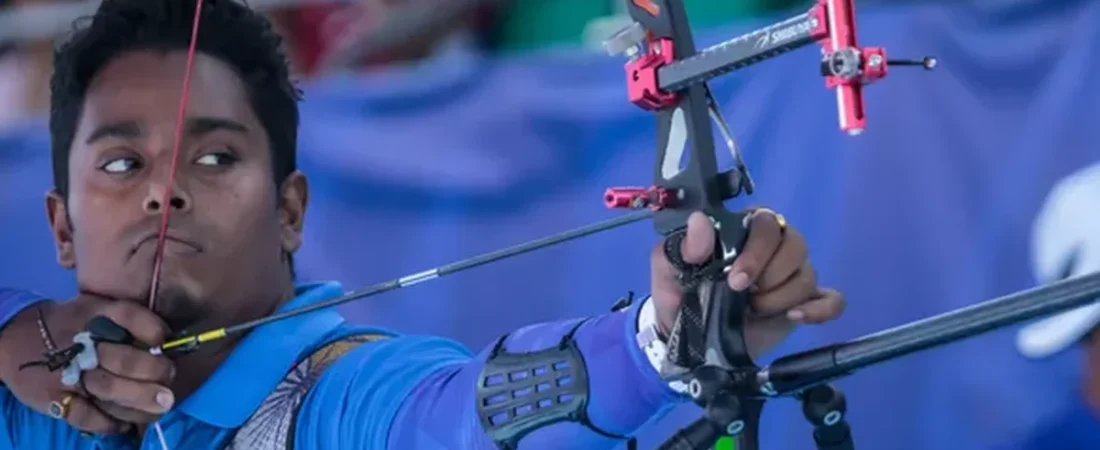
Some sporting achievements are so complete, so quietly decisive, that their true weight only settles in days later. The Kumkum Mohod archery gold at the Asian Games 2026 is one of them. On October 3, the final day of the Aichi-Nagoya Games, a 17-year-old competing in her debut Asian Games stepped onto the recurve line and did something no Indian woman had ever done: she beat Korea’s Yejin Oh 6-5 in the women’s individual recurve final to win gold. And because the stakes at these Games stretch far beyond a single afternoon, the teenager’s victory also booked her a place at the Los Angeles 2028 Olympics.
That sentence alone would make a career story. But this was not a solitary triumph. The Kumkum Mohod archery gold arrived as the headline of a wider Indian recurve revolution: alongside Ankita Bhakat and Kirti Sharma, Mohod helped India beat South Korea 5-3 for the country’s first Asian Games gold in the women’s recurve team event. India also added two recurve silvers — Mohod and Dhiraj Bommadevara as runners-up in the mixed team event, and the men’s trio of Dhiraj Bommadevara, Neeraj Chauhan and Yashdeep Bhoge taking silver in the team event. Days after India swept all three compound team titles, recurve archery produced the Games’ most emotional Indian chapter. This is the full story of that October afternoon and everything around it.
Kumkum Mohod Archery Gold: The 6-5 Final That Made History
The gold was decided the way great recurve finals so often are: not by a landslide, but by nerve. Set play in recurve archery is a duel of sets — points for sets won, not total arrows — and a 6-5 scoreline tells you everything about the tension. Against Yejin Oh of South Korea, a nation whose archers treat gold medals as an expectation rather than a dream, the 17-year-old Indian held her form set after set in a contest that swung back and forth across the afternoon.
What makes Mohod’s triumph remarkable is not just the margin but the matchup. Korea’s recurve programme is the deepest in world archery; its archers train inside a system that has dominated Olympic podiums for decades. For an Indian teenager in her first Asian Games to stand opposite that system in a gold-medal match and win 6-5 requires more than talent. It requires the kind of temperament coaches spend years trying to build — the ability to shoot the same arrow, the same way, with everything on the line, when the opponent refuses to blink.
The final was a reminder of why the set system produces drama. In recurve, a single arrow does not decide a match; sets do, and momentum can turn in a single end. The contest unfolded as a tactical battle as much as a shooting one: adjusting aim points, managing wind on the Aichi range, and answering every Korean response with one of her own. When the final set settled it at 6-5, Mohod had not just beaten Yejin Oh — she had announced the arrival of a new generation of Indian recurve archers on the biggest continental stage.
Debut Games, Debut Gold
The context deepens the achievement. At 17, this gold came in her debut Asian Games — her first exposure to the multi-sport pressure cooker where athletes compete alongside hundreds of teammates, in front of home and global media, with the weight of a nation’s medal tally in every shot. First-timers are supposed to learn, to absorb, to return stronger in four years. Mohod skipped the apprenticeship entirely.
There is a particular quality to debut-Games champions: they have not yet learned what they are supposed to be afraid of. Korean finalists, Olympic systems, decades of history — to a 17-year-old with nothing to lose, these are just details. Mohod shot like she belonged, and by the final arrow, nobody in the arena would have argued otherwise.
First Ever: Why This Gold Is a Landmark for Indian Archery
This is not simply India’s latest gold at Aichi-Nagoya. It is the first-ever women’s recurve individual gold for India at the Asian Games. That distinction matters enormously, because the women’s recurve individual event has long been one of the toughest medals to win in Asian sport. Korea’s dominance, China’s depth, and the sheer quality of the continental field have kept this particular gold out of Indian reach through edition after edition.
Consider the history. Indian archery has produced world-class recurve archers before — names that carried the tricolour into Olympic quarterfinals and World Cup finals. Yet the Asian Games women’s individual recurve title had always slipped away, often in finals or semifinals against Korean opposition. Mohod’s 6-5 win breaks that pattern at a stroke. She did not win a weakened event; she beat Korea’s Yejin Oh, the representative of the sport’s superpower, in the final itself.
This is the kind of result that rewires a programme’s psychology. For years, India’s recurve archers have walked onto ranges knowing that the path to gold runs through Korea. This victory proves the path is walkable. Every young recurve archer training in India today now has a concrete reference point: a 17-year-old who beat Korea 6-5 on the biggest stage. Barriers in sport are often mental before they are technical, and Mohod has demolished this one.
A Legacy Moment for Indian Women in Sport
Mohod’s triumph also belongs to a broader story of Indian women rewriting the record books at these Games. Across disciplines, the Aichi-Nagoya contingent has been defined by its women — champions, record-breakers, first-timers. Her achievement, as the first Indian woman to win this particular gold, sits at the very top of that list. At 17, she has time for at least three more Asian Games cycles; the legacy implications of that timeline, for Indian archery’s visibility and funding, are enormous.
Kumkum Mohod Archery Gold: The 5-3 Team Triumph Over Korea
If the individual gold was the headline, the women’s recurve team gold was the exclamation mark. Teaming up with Ankita Bhakat and Kirti Sharma, Mohod helped India beat South Korea 5-3 in the women’s recurve team final — India’s first Asian Games gold in the women’s recurve team event. Two firsts in one day, both achieved against Korean opposition, both led by a 17-year-old debutant.
The achievement gains even more power when you consider the team dynamics. Team recurve is a different discipline from individual competition: shooting order matters, rhythm matters, and the ability to lift teammates after a loose arrow is as important as the arrows themselves. Mohod shot in both events, carrying the momentum — and the pressure — of the individual triumph into the team final against the same Korean system she had just conquered.
Beating Korea 5-3 in a team final is a programme statement. South Korea’s women’s recurve team is arguably the most dominant unit in all of Olympic sport, across any discipline. The 5-3 scoreline shows a match that was contested, not conceded — India had to win sets, hold leads, and close out a team that never surrenders quietly. That the individual triumph was followed hours later by this team gold, with Mohod central to both, marks October 3 as the single greatest day in the history of Indian recurve archery.
Ankita Bhakat and Kirti Sharma: The Supporting Pillars
The story rightly centres on the teenager, but the team gold belongs to three archers. Ankita Bhakat brought experience and composure to the line, while Kirti Sharma contributed the kind of steady shooting that team finals demand. India’s first women’s recurve team gold at the Asian Games was won by a blend of youth and experience — and it is no coincidence that the same blend delivered the individual breakthrough on the same day.
Los Angeles 2028: The Quota Behind the Gold
The victory carried a prize beyond the podium: it booked Mohod a place at the Los Angeles 2028 Olympics in the women’s recurve individual event. In the Olympic qualification pathway, Asian Games success converts directly into quota places, and her 6-5 win over Yejin Oh secured India’s seat in the recurve competition at LA 2028.
This dimension of the triumph cannot be overstated. Olympic quotas are the currency of sports planning — they determine funding, selection timelines, and the shape of an athlete’s next two years. At 17, Mohod now has a clear runway to Los Angeles: two years to develop, to gain senior international experience, and to arrive at the Olympics not as a surprise qualifier but as an Asian Games champion. The win has effectively fast-forwarded her career by a full Olympic cycle.
There is also a symmetry worth noting. Days earlier, India’s compound archers had secured their own historic LA 2028 qualification — the first country to book a compound mixed team quota for the discipline’s Olympic debut — during the compound clean sweep that opened India’s golden archery week. With a recurve quota now added, India will head to Los Angeles with representation across both archery disciplines, a position of strength the programme has never enjoyed before.
What Two Years of Preparation Can Do
This gold gives Indian archery something it rarely has: certainty, early. Quotas won at the final qualification events leave months, not years, for preparation. A quota secured in October 2026 leaves nearly two full years. Selection trials can be planned, international exposure can be scheduled around a known target, and Mohod herself can be developed with a specific Olympic programme in mind. It is not just a result; it is the foundation of a two-year Olympic campaign.
Two Silvers Complete India’s Recurve Haul
The individual gold did not arrive alone. India’s recurve archers also collected two silvers on the range at Aichi-Nagoya, underlining the depth behind the golden headlines. Mohod herself, remarkably, added a mixed team silver alongside Dhiraj Bommadevara — meaning the 17-year-old leaves her debut Asian Games with two golds and a silver, a haul most athletes would trade entire careers for.
The men’s team event brought the second silver: Dhiraj Bommadevara, Neeraj Chauhan and Yashdeep Bhoge finished runners-up in the men’s recurve team competition. While gold eluded them, a silver in the men’s team event — against the same continental field that makes every Asian archery medal precious — confirms that India’s recurve strength runs across genders and formats. The teenager’s triumph may be the story of the Games, but the two silvers prove it was no fluke.
Taken together, India’s recurve medal collection — two golds and two silvers — represents a transformation. Recurve archery at the Asian Games has historically been Korean territory with occasional challengers. At Aichi-Nagoya, India were not challengers; they were champions. The golden afternoon led the way, but the full haul shows a programme operating at a new level.
Dhiraj Bommadevara’s Double Contribution
Worth special mention is Dhiraj Bommadevara, who medalled in both the mixed team event (silver, with Mohod) and the men’s team event (silver, with Neeraj Chauhan and Yashdeep Bhoge). While the headlines will focus on the teenager, Bommadevara’s consistency across two events demonstrates the squad depth that made India’s recurve week possible. Champions need teammates; India’s recurve team had them.
From Compound Sweep to Recurve Glory: Archery’s Golden Week
The Kumkum Mohod archery gold cannot be understood without its context: just days earlier, on September 30, India had swept all three compound team golds at these Games — women’s team, mixed team, and men’s team — in a single historic afternoon. That compound clean sweep was itself unprecedented. The individual and team recurve triumphs that followed mean archery became one of India’s most successful sports at the entire Games.
Consider the full archery ledger. Compound: three team golds, including a world-record-equalling score and the first-ever LA 2028 compound mixed team Olympic quota. Recurve: individual gold, the first women’s recurve team gold, and two silvers. Across both disciplines, India dominated the archery ranges at Aichi-Nagoya in a way no nation besides Korea has managed in recent memory.
This is a structural story, not a lucky week. Indian archery has been building for years — through academies, international exposure, sports-science support, and a pipeline that now produces 17-year-old champions. Mohod’s victory is the most visible proof of that system’s maturity, but the compound sweep and the recurve silvers show the same system working at every level. As our analysis of India’s medal tally noted, India’s golds increasingly come from sports with professional ecosystems — archery now belongs firmly in that category.
The Fortress Sport Theory, Confirmed Again
Mohod’s gold fits the pattern identified across India’s campaign: golds come from ecosystems. Cricket has its domestic structure, kabaddi has its professional league — both kabaddi teams beat Iran for double gold — and archery now has a production line that delivered across two disciplines in a single week. This is what a mature sporting ecosystem looks like at its best.
What This Triumph Changes for Indian Sport
Mohod’s win changes the arithmetic of Indian archery’s future. A 17-year-old Asian Games champion with an Olympic quota in hand becomes the face of the programme — for sponsors, for young athletes choosing sports, for the federation’s planning. Visibility drives participation; participation drives the next generation. This gold will be the image on posters in archery academies across India for years.
It also changes expectations. Before Aichi-Nagoya, an Indian recurve gold against Korea in a major final was a hope. After this 6-5 triumph — in a debut Games, at 17 — it is a precedent. The next Indian recurve archer who faces Korea in a final will walk to the line knowing it has been done. That psychological shift, across the whole squad, may be the most valuable thing Mohod won on October 3.
For the latest on how India’s final-day golds shaped the standings, see Mint’s October 3 medal tally coverage and The Times of Bengal’s report on India’s six-gold day and move to fifth with 76 medals.
The Kumkum Mohod archery gold also arrives at a moment when Indian sport is asking harder questions about conversion — turning finalists into champions. Mohod answered that question personally: two finals, two golds, one Olympic quota.
Finally, this is a reminder of what the Asian Games are for. Medals matter, quotas matter, tallies matter — but the Games also exist to reveal the future. On the final day at Aichi-Nagoya, the future of Indian archery picked up a bow, beat Korea 6-5, and walked into history. She is 17. Los Angeles is two years away. The Kumkum Mohod archery gold is not an ending; it is a beginning.
Why this story matters: The Kumkum Mohod archery gold — a 6-5 win over Korea’s Yejin Oh at 17, in her debut Asian Games — gave India its first women’s recurve individual gold, an LA 2028 quota, and proof that a new generation can beat the sport’s superpower on the biggest stage.