
Table of Contents
– The Neeru Dhanda Asian Games Final: 28 Hits, One First
– 28/30: Anatomy of an Asian Record in Women’s Trap
– Two Medals in One Day: The Neeru Dhanda Asian Games Double
– What the Neeru Dhanda Asian Games Gold Means for India’s Medal Tally
– India’s Day Across Sports in Aichi-Nagoya
– Why Trap, Why Now: Depth in Indian Shooting
– What’s Next for the Neeru Dhanda Asian Games Record Holder
– Conclusion: The Curse, Broken
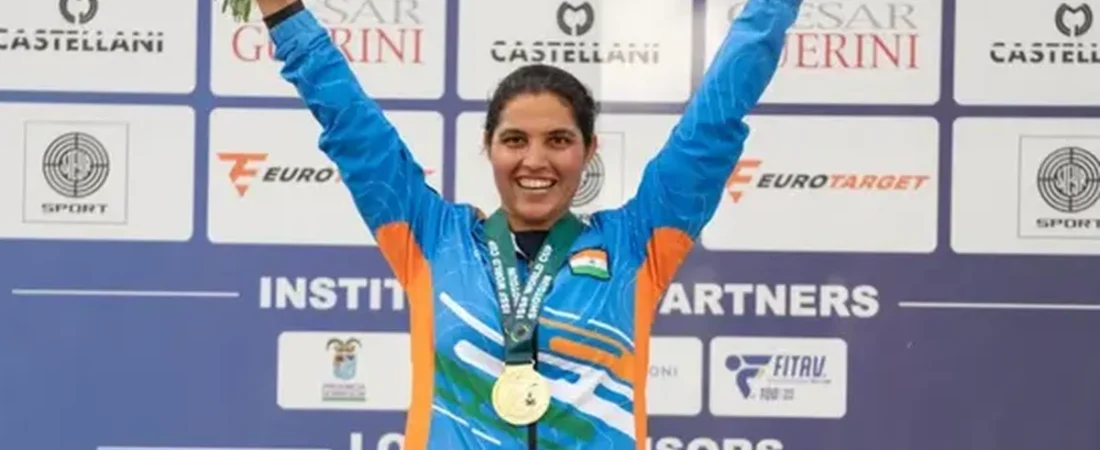
The Neeru Dhanda Asian Games story reached its highest point on a Tuesday morning in Aichi-Nagoya. India’s trap shooter walked into the women’s trap final and produced a performance for the history books. She hit 28 of 30 targets. That score smashed the previous Asian record of 24 by four targets.
It was also the moment India’s campaign found its individual star. Until that morning, every one of India’s gold medals at these Games had come from team events. Dhanda changed that in a single round of shooting. She also became the first Indian woman ever to win an individual Asian Games gold in trap shooting.
Three firsts in one final. That is the kind of afternoon athletes spend whole careers chasing. For India, it was the day the individual curse finally broke.
The Neeru Dhanda Asian Games Final: 28 Hits, One First
Shooting finals at the Asian Games are tense, quiet affairs. There is no crowd roar between shots. The leaderboard updates in real time, and every miss is visible. Into that pressure cooker walked Neeru Dhanda. She left as an Asian record holder. The Neeru Dhanda Asian Games final will be replayed for years, not just for the score but for the composure behind it. Teammates and coaches later described a shooter who looked calmer as the stakes rose. Each call of “pull” was met with the same unhurried mount, the same clean break of the target. By the midway point of the final, the scoreboard told its own story: a gap was opening, and it was not closing.
That is the mark of a champion’s afternoon. The Neeru Dhanda Asian Games gold was never really in doubt in the closing stages, because she had done the hard work early, banking hits while her rivals were still finding rhythm.
A Record Four Targets Better Than the Old Mark
The previous Asian record in women’s trap stood at 24. That mark had been the continental benchmark for years. Dhanda shot 28/30, bettering it by four full targets. In a discipline decided by single clays, four targets is a landslide.
Her run was built on consistency rather than a lucky streak. Misses in trap shooting usually come in clusters, when rhythm breaks. Dhanda refused to let that happen. She stayed locked in across all 30 targets, treating each clay like the first one of the day.
Sun Yunong and Hajar Abdulmalik Complete the Podium
China’s Sun Yunong took silver with 26. That score would have won plenty of major finals. On this day, it was two targets short of gold. Kuwait’s Hajar Abdulmalik claimed bronze with 21.
The gap told the story. Dhanda finished two clear of the silver medallist and seven ahead of bronze. In a final where the previous record was 24, she made 26 look ordinary. The Neeru Dhanda Asian Games final was less a contest and more a coronation.
First Indian Woman to Win Individual Trap Gold
Beyond the record, Dhanda claimed a historic first. She is the first Indian woman ever to win an individual Asian Games gold in trap shooting. No Indian woman had stood alone on top of an Asian Games trap podium before.
That matters because firsts are permanent. Records fall. Someone, someday, will shoot 29 or 30. But no one can ever again be the first Indian woman to win this gold. The Neeru Dhanda Asian Games triumph carved her name into that list forever.
28/30: Anatomy of an Asian Record in Women’s Trap
To appreciate what Dhanda did, it helps to understand the discipline. Trap shooting is unforgiving. Targets fly away from the shooter at unpredictable angles and speeds. There is no second chance on a clay.
What 28 Out of 30 Means in Trap Shooting
Hitting 28 of 30 in a major final is extraordinary. The previous Asian record of 24 existed because 24 was already a superb score under final pressure. Dhanda beat it by four. She did not edge the record. She demolished it.
Think of it in sporting terms. This was not a photo finish. It was a new standard, set so far above the old one that it may stand for years. The Neeru Dhanda Asian Games record now gives every trap shooter in Asia a new number to chase.
The Mental Game of 30 Targets
Shooting finals test temperament as much as technique. Thirty targets come one after another. The leaderboard shifts with every shot. There is no teammate to carry the load, no timeout to regroup.
Dhanda’s 28/30 in that environment reveals an athlete whose temperament matches her technique. She did not tighten up as the record came into view. She did not play safe to protect a lead. She kept attacking each target. Records like this do not fall by accident. They fall to shooters already thinking past the record.
The Neeru Dhanda Asian Games Benchmark for the Continent
Asia’s shooting map has just been redrawn. Before this final, the continent’s elite trained to a standard of 24. Coaches across China, Kuwait, and beyond will now recalibrate around 28. The Neeru Dhanda Asian Games record does not just raise the bar; it moves it to a different room.
This is how disciplines evolve. One athlete shows what is possible, and the field follows. Within a cycle or two, 26 and 27 will become ordinary winning scores in Asian women’s trap. The Neeru Dhanda Asian Games 28/30 will be the score everyone measures themselves against until someone dares to go past it.
That is the difference between winning a final and defining an era. Dhanda did both.
Two Medals in One Day: The Neeru Dhanda Asian Games Double
Remarkably, Dhanda was not done after the individual final. She returned to the range later in the day and added a second medal to her collection. Two medals in one day, one of them historic, made September 29 hers.
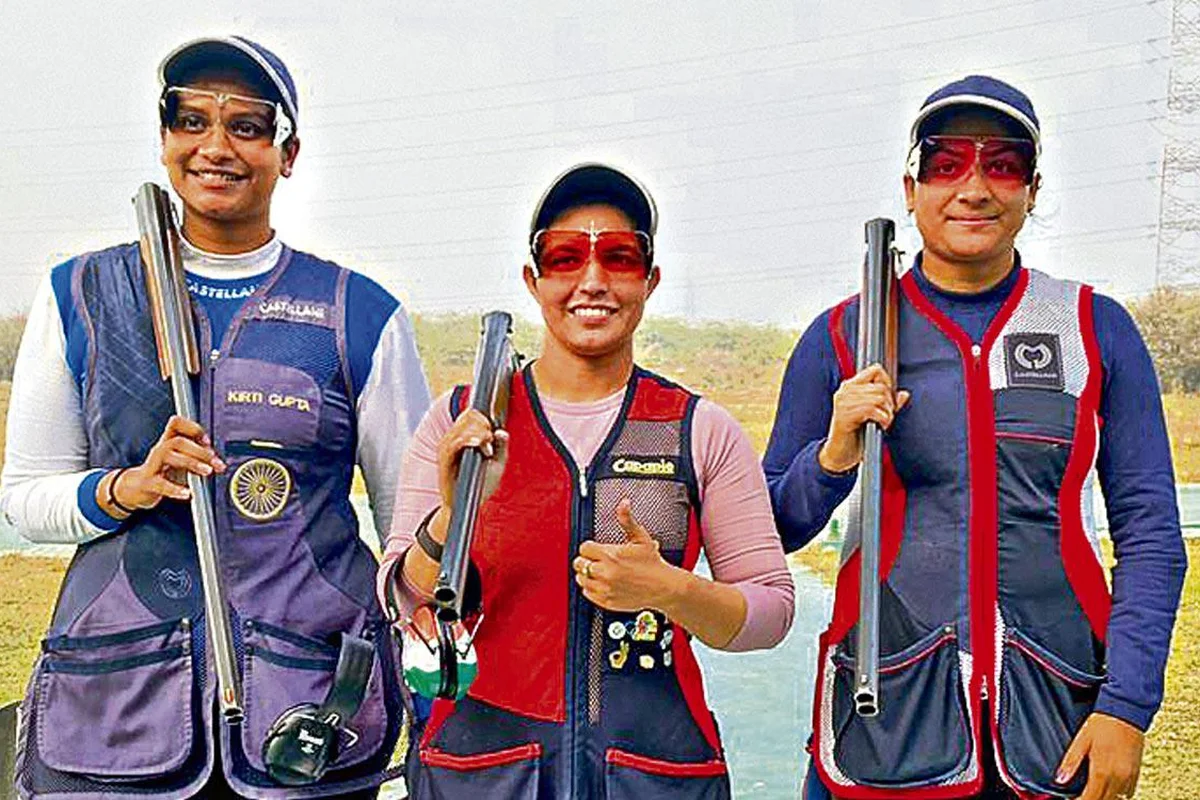
Team Silver with Ahlawat and Keer
Dhanda teamed up with Aashima Ahlawat and Manisha Keer in the women’s trap team event. The trio scored 328 to take silver. They finished behind China, who posted 346, and just ahead of Kuwait on 325.
The margins were tight. Three points separated India from Kuwait in the race for silver. Eighteen points separated them from China and gold. The Neeru Dhanda Asian Games double showed that India now have genuine depth in the discipline, not just one star.
The Squad, Not the Individual
It would be wrong to treat the team silver as a footnote. A fiercely contested podium underlines something important: India’s women’s trap squad is not a one-woman operation.
China remain the benchmark in the discipline. Closing an 18-point gap to them is the next mountain to climb. But for the first time, India have a trap team that belongs in the same conversation as the continent’s best. And that team is led by a newly crowned Asian record holder.
The Neeru Dhanda Asian Games double also answered a quiet question hanging over Indian shooting: could the country’s trap programme produce results when it mattered most? One gold and one silver in a single day is a loud answer. Ahlawat and Keer played their part under real pressure, holding off Kuwait in a three-point scrap for silver. The Neeru Dhanda Asian Games story is an individual triumph, but the team medal proves the ecosystem around her is healthy too.
What the Neeru Dhanda Asian Games Gold Means for India’s Medal Tally
Context turns a great result into a campaign-defining one. India arrived in Aichi-Nagoya with 503 athletes competing across 36 sports. The contingent had collected medals steadily, including plenty of silver. But the gold count told a frustrating story until Dhanda’s final.
First Individual Gold of the Campaign
Every Indian gold before Dhanda’s had come with an asterisk of shared glory. Four golds, all in team events, where the weight of expectation is distributed across a squad. Dhanda’s was India’s first individual gold of the Games.
Individual gold is different. It names a champion. It gives the contingent a face and the country a story. For the latest picture of how the gold reshaped the standings, see India’s Asian Games 2026 medal tally. The Neeru Dhanda Asian Games gold sits at the top of that story now.
A Contingent of 503 Finds Its Face
India sent 503 athletes to Aichi-Nagoya, spread across 36 sports. That is one of the largest contingents in the country’s Asian Games history. With size comes expectation, and with expectation comes pressure.
Until September 29, that pressure was building. Medals were coming, but the top individual honour had not. The Neeru Dhanda Asian Games gold released all of it in one afternoon. Suddenly the contingent had a face, a name, and a number: 28/30. For the athletes still to compete in the final days, that is the most powerful message possible. The standard has been set by one of their own.
For a contingent collecting silvers by the dozen, a first-of-its-kind individual gold changes the texture of a whole campaign. Team golds are celebrated. Individual golds are immortalised. These are the medals with a name, a face, and a story attached.
Coming when it did, with the Games entering their final stretch and the gold count stubbornly low, Dhanda’s triumph gave the rest of the squad something just as valuable as the medal itself. It gave them proof. Proof that the top step of the podium is reachable, and that it can be reached by an Indian, alone, on the biggest stage.
India’s Day Across Sports in Aichi-Nagoya
Dhanda’s double was the headline, but September 29 was a productive day for India across the board. The shooting range was the epicentre, yet Indian athletes were collecting results elsewhere too as the Games moved toward their conclusion.
Shooting: India’s Medal Factory
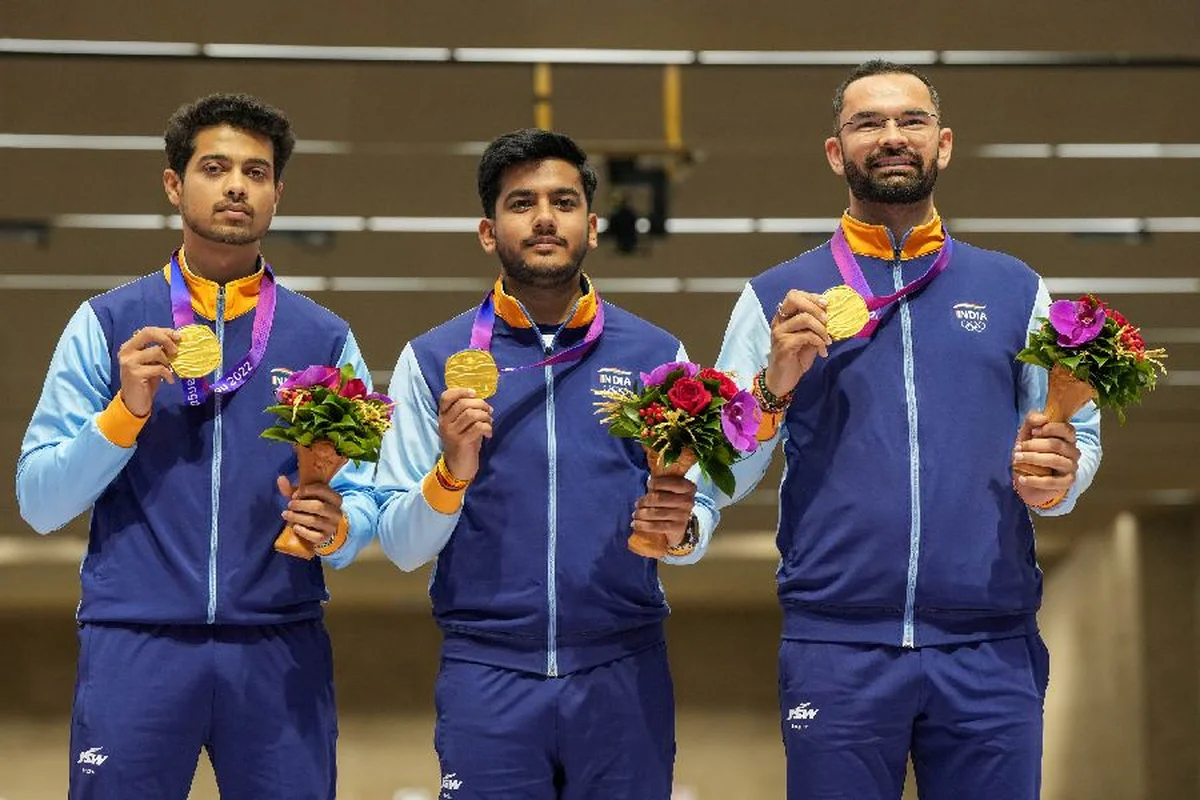
The Neeru Dhanda Asian Games heroics continued a quietly superb shooting campaign. Earlier in the Games, the 10m air pistol mixed team pair of Suruchi Singh Inder and Kamaljeet delivered gold. Esha Singh added a silver in the women’s 25m air pistol.
Shooting has been India’s most reliable medal factory in Aichi-Nagoya. Now it has its headline act. Dhanda’s record-breaking gold in a non-traditional discipline suggests the pipeline is producing champions across events, not just in rifle and pistol strongholds.
Beyond the Range
Indian athletes were in action across multiple venues as the Asian Games entered their final phase. Track and field, in particular, continued to deliver moments for the contingent. For the full roundup of those results, read India’s track and field medals in Aichi.
The broader point stands. India’s 503-strong contingent across 36 sports was built to compete everywhere. But it was on the shooting range, on September 29, that the campaign found the result it will be remembered for.
Why Trap, Why Now: Depth in Indian Shooting
Indian shooting has a pattern. Prodigious talent, steady team medals, and a tendency for the biggest individual prizes to slip away at the final hurdle. Dhanda’s afternoon broke that pattern in the most emphatic way possible: by rewriting the record book rather than just winning it.
A Non-Traditional Stronghold
Trap is not one of India’s traditional shooting strongholds the way rifle and pistol are. Indian shooting’s reputation was built in those disciplines. A record-breaking gold in trap therefore signals something bigger than one athlete’s brilliance.
It signals depth. It suggests the system, the academies, the coaching, and the funding pipelines are producing champions across disciplines rather than in one or two favoured lanes. The Neeru Dhanda Asian Games gold is proof of concept for Indian shooting’s breadth.
What the Neeru Dhanda Asian Games Gold Does for Grassroots
Every record creates a ripple. In academies and ranges across India, young trap shooters will now train with a concrete target: 28. Not an abstract dream of gold, but a number posted by an Indian, at an Asian Games, in a final.
The Neeru Dhanda Asian Games effect will be felt in funding conversations too. Medals open doors; records open budgets. A discipline that was not a traditional stronghold now has its standard-bearer and its proof of concept. Expect more ranges, more coaches, and more juniors picking up a shotgun because of one Tuesday in Aichi-Nagoya.
One-off medals can be accidents of form. A 28/30 Asian record in a major final is not. It is the product of preparation meeting temperament on the right day.
The next generation of Indian trap shooters now has a name to chase, a number to beat, and proof that it can be done. That is how systems grow: not through spikes of brilliance, but through standards that others can see and follow.
What’s Next for the Neeru Dhanda Asian Games Record Holder
Dhanda’s gold reframes the conversation about Indian shooting’s next cycle. The sport has no shortage of young talent. The mixed team gold for Suruchi Singh Inder and Kamaljeet proved that. What it sometimes lacked was a signature individual triumph at the Asian level to build a narrative around. Now it has one.
World Cups and the Olympic Road
The World Cup circuit and, eventually, the Olympics are the next proving grounds. Trap shooting at the global level is deeper and more ruthless than even the Asian field. But Dhanda has shown she is built for the biggest stages.
Fans following the international circuit can track the sport’s biggest events through Olympics.com shooting coverage, while the ISSF — International Shooting Sport Federation remains the home of rankings, rules, and World Cup schedules.
Built for the Biggest Stages
Trap shooting demands a particular kind of athlete. Explosive reactions married to absolute calm. The ability to read a target’s flight in fractions of a second and commit without hesitation.
That Dhanda delivered her record in a major final, with the continent watching, says everything about her temperament. If this afternoon is any indication, she will not be overawed by what comes next. The Neeru Dhanda Asian Games story may only be getting started.
Conclusion: The Curse, Broken
Some afternoons are just like that. The kind athletes spend their whole careers chasing, and the kind that remind everyone watching why sport is worth the wait. A shooter walked into a final, broke an Asian record by four targets, and gave her country its first individual gold of the Games.
The record may fall one day. The firsts are hers forever. Dhanda has joined a very short list of Indian athletes who can say they stood alone on top of the Asian podium. She did it in the least expected discipline of all, with a score the continent had never seen before.
When the story of India’s Aichi-Nagoya campaign is written, September 29 will be Neeru Dhanda’s day. The day the individual curse broke, the record fell, and Indian shooting found its new standard-bearer. The Neeru Dhanda Asian Games triumph is the result the whole campaign will be measured against.
Years from now, young shooters will be told about the afternoon an Indian walked into a women’s trap final and shot 28/30. They will hear the number before they hear the name. That is what records do: they outlive the moment and become the measure. The Neeru Dhanda Asian Games legacy is already secure, whatever comes next.
Why this story matters: Dhanda’s 28/30 didn’t just win gold; it set a new Asian record and gave India its first individual champion of the Games. In a campaign heavy on silver, she found the colour that matters.