
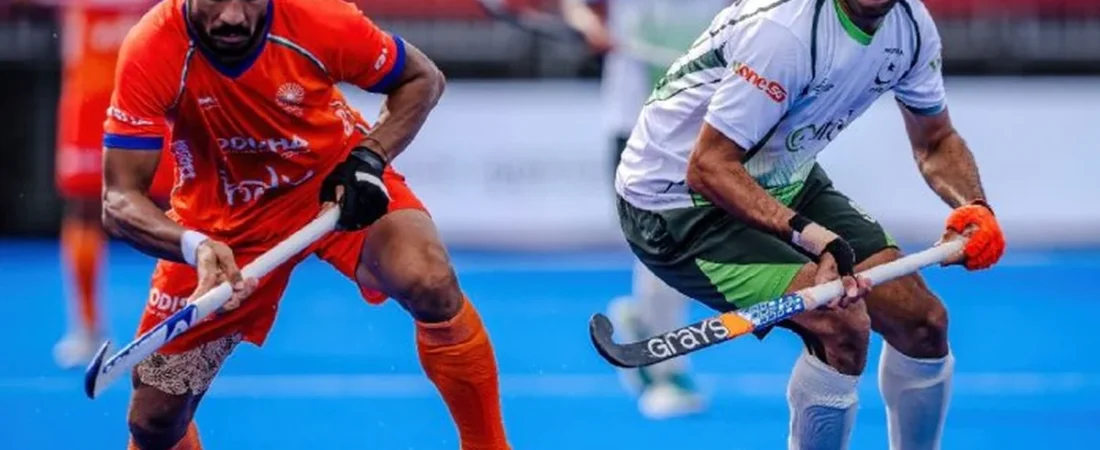
Some matches are won. Some are survived. And once in a generation, a match arrives that is somehow both — and becomes part of a rivalry’s mythology in the space of sixty minutes. The India beat Pakistan hockey semifinal at the Asian Games 2026 was one of those. On October 1, 2026, at the Gifu Prefectural Green Stadium in Kakamigahara, defending champions India beat Pakistan 4-3 in a semifinal that swung from procession to panic to pure theatre, sealed by Abhishek’s deflected winner with just 49.2 seconds on the clock.
India were 3-0 up and cruising. Pakistan fought back to 3-3. The stadium went silent, then erupted, then went silent again. In the end, the India beat Pakistan hockey semifinal delivered everything the rivalry has ever promised: Harmanpreet Singh’s penalty-corner mastery, a comeback written in green-shirted defiance, and a last-gasp winner that sent the defending champions into the October 3 final against Malaysia, one win away from a direct LA 2028 Olympics berth. This is the full story of an extraordinary night.
India Beat Pakistan Hockey Semifinal: The Lightning Start
The first five minutes of the India beat Pakistan hockey semifinal told a story of total Indian intent. From the opening whistle, the defending champions pressed high, moved the ball with pace and earned a penalty corner within minutes. Pakistan’s defence held its breath. It had reason to be nervous: standing at the top of the circle was Harmanpreet Singh, the tournament’s most feared drag-flicker, the captain who had already amassed 10 goals in these Games, second only to Pakistan’s own Sufiyan Khan on the scoring charts.
In the 5th minute, Harmanpreet unleashed. His drag-flick was not the elegant, curling effort that decorates highlight reels — it was a cannon through the legs of Pakistan defender Ali Reza, unstoppable and unarguable. One-nil India. The Pakistan goalkeeper had barely moved. The Indian bench was on its feet, and the small but vocal Indian contingent in Kakamigahara had its first roar of the evening. The India beat Pakistan hockey semifinal had its opening chapter, and it was written in the language India speak best: the penalty corner.
Eight minutes later, history repeated itself with variations. Another penalty corner, another Harmanpreet drag-flick — this time lower, threading the ball through the post defender and the charging rusher to find the same corner of the net. In the 13th minute, India were 2-0 ahead, and Pakistan were reeling. Two penalty corners, two goals. The set-piece machine that had powered India’s pool-stage annihilation — 49 goals scored, four conceded, five wins from five — was operating at full throttle when it mattered most.
Why the Early Goals Mattered So Much
Early goals in knockout hockey do more than change the scoreboard; they change the geometry of the entire match. Pakistan’s game plan — compact, counter-attacking, patient — was built on staying level for as long as possible and then striking against the run of play. Two goals down inside thirteen minutes, that plan was in ruins before the first quarter had ended. Pakistan had to chase. Chasing against India’s press is one of the most dangerous things a team can do in Asian hockey.
The statistics of the opening quarter of this India beat Pakistan hockey semifinal bore this out. India dominated possession, racked up circle entries and forced Pakistan into a defensive posture they had not wanted to adopt. Every Indian foray into the circle carried menace; every Pakistani clearance felt temporary. The India beat Pakistan hockey semifinal was, at this stage, a demonstration of what the favourites can do when their weapons fire early.
Three-Up and Cruising: Sukhjeet’s 24th-Minute Strike
If the first quarter belonged to Harmanpreet’s flicks, the second quarter belonged to India’s fluid attacking hockey. The defending champions did not sit on their lead. They kept coming — wave after wave of structured, high-tempo attack that had become their trademark under coach Craig Fulton. Pakistan defended deeper and deeper, their shape stretching, their clearances growing more desperate.
In the 24th minute, the pressure told. Shilanand Lakra, the young forward who had been one of the stories of India’s pool campaign, collected the ball down the left and drove into the circle before sending a perfect squared cross into the danger zone. Sukhjeet Singh was exactly where a poacher should be — ghosting into the middle, meeting the ball first, deflecting it past the goalkeeper. Three-nil. India were cruising, and the semifinal was beginning to look like another Indian procession. Many in the stadium began to think of the final on October 3. Pakistan had other ideas.
The Danger Hidden in a 3-0 Lead
Here is the truth about 3-0 leads in hockey: they are the most dangerous scoreline in the sport. Comfort breeds a fraction less intensity. A fraction less intensity against a team with nothing to lose is an invitation. And just before half-time, Pakistan accepted it. Abu Mahmood stepped up to a penalty corner, struck his drag-flick, and watched the ball deflect off Mohith and loop into the Indian goal. Three-one. It was a lucky goal — but luck, in an India beat Pakistan hockey semifinal comeback, is often the spark that starts the fire.
At half-time, the India beat Pakistan hockey semifinal stood at 3-1. India were still in control. But the last kick of the half had changed the emotional temperature of the match. Pakistan had something to hold onto. In their dressing room, the message would have been simple: one more, and it is a contest.
Pakistan’s Fightback: From 0-3 to 3-3
The second half of the India beat Pakistan hockey semifinal is the part that will be replayed for years in Pakistan — and studied with a shudder in India. Pakistan emerged from the break with renewed belief and a tactical adjustment: higher pressing, quicker transitions, and a willingness to commit numbers forward that they had lacked in the first half.
The turning point of the comeback arrived in the 44th minute. Dilpreet Singh, one of India’s nine-goal tournament stars, received a green card and was suspended for two minutes. India were down to ten men. Pakistan, sensing blood, capitalised ruthlessly. Hannan Shahid struck in the 45th minute to make it 3-2, and suddenly the defending champions were under genuine pressure for the first time in the entire tournament.
Then, in the 49th minute, the stadium fell silent. Waheed Ashraf Rana found the net. Three-all. From 3-0 to 3-3, Pakistan had completed one of the great comebacks in the history of this fixture. The Indian players looked stunned. The Pakistan bench was delirious. The India beat Pakistan hockey semifinal had become something nobody had predicted: a genuine, nerve-shredding contest with eleven minutes to play and everything — the final, the Olympic berth, the rivalry’s honour — hanging in the balance.
The Green Card That Changed Everything
It is worth pausing on the green card, because small moments decide big matches. Dilpreet’s two-minute suspension arrived at precisely the moment Pakistan needed oxygen. A man advantage in hockey is enormous — space opens, rotations break down, the extra body in attack creates overloads that a set defence cannot absorb. Pakistan used those two minutes to seize the initiative, and they never fully gave it back until the dying seconds. India, for all their dominance, learned a harsh lesson in this India beat Pakistan hockey semifinal: in knockout hockey, discipline is not a virtue; it is a weapon.
49.2 Seconds: Abhishek’s Last-Gasp Winner
What happened next is the reason the India beat Pakistan hockey semifinal will be remembered as a classic rather than a cautionary tale. India, champions do what champions do, refused to fold. The final quarter became a war of attrition — both sides exhausted, both defences stretched, the ball pinging from circle to circle as the clock ticked toward a shootout that neither team truly wanted.
There were heart-stopping moments at both ends. Amit Rohidas produced a crucial block on a late Pakistan penalty corner, throwing his body in front of a drag-flick that could have completed the most famous Pakistani comeback in decades. Pakistan successfully reviewed an Indian penalty decision with 90 seconds left, surviving by the width of a video umpire’s call. The tension in Kakamigahara was unbearable.
And then, with 49.2 seconds remaining, Abhishek struck. Collecting the ball in a crowded circle amid a chaotic scramble, he unleashed a shot that deflected off the stick of Pakistan defender Sufiyan and wrong-footed the goalkeeper. Four-three. The Indian bench exploded. The players mobbed Abhishek. Pakistan’s players stood frozen, fifty seconds from a shootout, now beaten by the cruelest deflection of the tournament.
Fifty Seconds of Eternity
The remaining 49.2 seconds were an eternity. Pakistan threw everything forward, pulling players into attack in desperation. India defended with their lives — sticks, bodies, and sheer will keeping the ball away from their circle. When the final hooter sounded, the defending champions had done it. They had beaten Pakistan 4-3. They had survived their own semifinal. The India beat Pakistan hockey semifinal ended with India in the final and Pakistan in tears — the exact script of this rivalry’s greatest nights, only this time the drama was almost too much to bear.
The Tactical Battle That Shaped the Semifinal
Beneath the emotion of the India beat Pakistan hockey semifinal sat a fascinating tactical contest. India, under Craig Fulton, play a structured, high-pressing game built on control: win the ball high, move it quickly through the midfield, create circle entries in waves, and convert penalty corners at a rate that makes them the most reliable scoring mechanism in Asian hockey. In the first half, that system functioned perfectly. Pakistan could not get out.
Pakistan’s response in the second half was tactically astute. They pressed higher themselves, disrupting India’s build-up and forcing turnovers in midfield. They committed to vertical, direct attacks rather than trying to play through India’s press. And critically, they exploited the numerical advantage during Dilpreet’s suspension with ruthless efficiency. It was a reminder that Pakistan, for all their struggles as a programme, still possess hockey intelligence and the individual quality to hurt anyone when the game opens up.
The Penalty-Corner War
The penalty-corner battle, as predicted in our preview of this semifinal, proved decisive. India’s conversions through Harmanpreet built the lead; Pakistan’s conversions through Abu Mahmood started the comeback; Amit Rohidas’s late block on a Pakistani corner may have saved the match. In a 4-3 thriller, the set piece was the difference between glory and a shootout lottery. For the full tactical breakdown from the night, Khelnow’s match report tracks how the momentum swung quarter by quarter.
Discipline as a Deciding Factor
India will review the green card with frustration, but they will also take pride in how they responded to adversity. Champions are not defined by never facing trouble; they are defined by what they do when trouble arrives. Conceding a 3-0 lead in a semifinal against Pakistan, with the stadium holding its breath, would have broken lesser teams. India found a winner. That, more than the pool-stage routs, is the performance that will give them belief going into the final.
Heroes of the Night: Harmanpreet, Mandeep and Nilakanta
Every classic has its heroes, and the India beat Pakistan hockey semifinal had several. Harmanpreet Singh’s brace — two drag-flicks in the 5th and 13th minutes — took his tournament tally to 10 goals, second only to Pakistan’s Sufiyan Khan on the scoring charts. The captain led from the front in the most literal sense: when India needed early authority, he provided it with the weapon that makes him the most feared flicker in Asian hockey.
Abhishek, the match-winner of this India beat Pakistan hockey semifinal, deserves his own paragraph in history. His deflected strike with 49.2 seconds left was not the cleanest goal he will ever score, but it may be the most important. Strikers are judged on decisive moments, and Abhishek — already on 9 tournament goals alongside Dilpreet Singh — chose the biggest possible stage to deliver. Sukhjeet Singh’s 24th-minute deflection, the goal that made it 3-0, should not be forgotten either; at the time, it looked like the goal that had settled the semifinal.
Mandeep Singh’s 300th Cap
The night was also a landmark for Mandeep Singh, who made his 300th senior international appearance in the India beat Pakistan hockey semifinal. Three hundred caps is a monument to longevity, consistency and excellence — and to do it in a semifinal against Pakistan, in a 4-3 thriller, is the kind of stage the milestone deserved. Hockey India marked the occasion, and the veteran forward’s experience was visible in the frantic closing minutes as India managed the game home.
Nilakanta’s Seamless Step-In
India were forced into one change for this India beat Pakistan hockey semifinal: Raj Kumar Pal was ruled out with a thumb fracture suffered in the final pool match against Bangladesh, and Nilakanta Sharma stepped into the lineup. Losing a key midfielder on the morning of a semifinal against Pakistan is the stuff of nightmares, but Nilakanta slotted in seamlessly, providing the link play and defensive cover that allowed India’s system to function. Squad depth wins tournaments; on this evidence, India’s runs very deep indeed.
India Beat Pakistan Hockey Semifinal in Rivalry Context
To understand why the India beat Pakistan hockey semifinal matters so much, you have to understand the fixture. India and Pakistan are the two most storied nations in Asian hockey history, with eleven Olympic gold medals between them. For decades, the Asian Games hockey final was practically their private property. The recent chapter has been one-sided — India thrashed Pakistan 10-2 in the pool stage at Hangzhou 2023, the heaviest defeat Pakistan have ever suffered in the fixture — but semifinals have a habit of compressing form into sixty minutes of nerves.
And so it proved. Pakistan, beaten 10-2 three years ago, pushed the defending champions to the final minute. The 4-3 scoreline, dramatic as it was, also confirmed the broader trend: India remain the stronger side, but Pakistan in a knockout match remain Pakistan — dangerous, proud, and capable of the extraordinary. This was no 10-2. It was a classic, and classics require two teams.
India’s Road to the Semifinal
India arrived at the semifinal with a perfect record: 13-1 over Indonesia, 16-1 over Sri Lanka, 8-2 over South Korea, 2-0 over Japan, and 10-0 over Bangladesh. Forty-nine goals scored, four conceded, five wins from five, a +45 goal difference. The numbers were absurd — but as this semifinal proved, pool-stage dominance guarantees nothing in knockout hockey. India will take two lessons into the final: their system works, and their composure under fire works too.
What Next: Malaysia Final and the Road to LA 2028
The reward for surviving this India beat Pakistan hockey semifinal is a final against Malaysia on October 3 at 3:30 PM IST — and a prize far bigger than gold. The Asian Games champions earn a direct berth at the LA 2028 Olympics, bypassing the brutal qualifying tournaments where one bad quarter can end a four-year cycle. India know this road well: they walked it in Hangzhou, winning gold and booking their ticket early. For a full look at the final, Khelnow’s India vs Malaysia final preview breaks down the matchup.
Malaysia will have watched this India beat Pakistan hockey semifinal with interest. They will have noted India’s vulnerability during the green-card suspension, Pakistan’s success in pressing India’s build-up, and the fact that the defending champions can be rattled. But they will also have noted the most important thing of all: when the match was on the line, India found a way. Champions do.
Why the Olympic Berth Matters
Direct Olympic qualification is the hidden stakes of every Asian Games hockey tournament. The qualifying events are congested, unforgiving marathons; avoiding them gives a team an extra year of planned preparation for Los Angeles. India’s women have already secured their berth with gold — the men now have one match to join them. Two hockey golds and two Olympic tickets from one Asian Games would be a historic achievement for Indian hockey, and after the drama of the India beat Pakistan hockey semifinal, the men’s team are 60 minutes away. Sporting News’ Asian Games hockey hub has the full schedule, squads and results as the finals approach.
Scorecard: The Night in Numbers
For all the drama, the numbers behind the India beat Pakistan hockey semifinal tell their own story:
| Detail | India | Pakistan |
|---|---|---|
| Final score | 4 | 3 |
| Goal scorers | Harmanpreet Singh (5′, 13′), Sukhjeet Singh (24′), Abhishek (60′) | Abu Mahmood (30′), Hannan Shahid (45′), Waheed Ashraf Rana (49′) |
| Halftime score | 3-1 | — |
| Winning goal | Abhishek, 49.2 seconds remaining (deflected off Sufiyan) | — |
| Green cards | 1 (Dilpreet Singh, 44′) | — |
| Milestone | Mandeep Singh — 300th senior international cap | — |
| Tournament goals (India) | Harmanpreet 10, Abhishek 9, Dilpreet Singh 9 | Sufiyan Khan leads charts |
The India beat Pakistan hockey semifinal also sits within a golden wider campaign for India at these Games — a campaign we have tracked throughout, from the kabaddi double gold against Iran to our analysis of India’s 60-medal tally. Hockey’s gold, if it comes on October 3, would be among the sweetest of them all.
Legacy of a Semifinal for the Ages
Years from now, when the India beat Pakistan hockey semifinal of October 1, 2026 is discussed, the details will blur but the feeling will remain: the shock of 3-0, the disbelief of 3-3, the explosion of 4-3 with 49.2 seconds left. It had everything — a captain’s brace, a comeback for the ages, a green card, a 300th cap, a fractured thumb, a last-gasp deflection, and a final at stake with an Olympic ticket attached.
For India, it was a reminder that defending a title is harder than winning one — every opponent raises their game, every lead is fragile, every semifinal can become a classic. For Pakistan, it was a different kind of statement: the 10-2 humiliation of Hangzhou is history, and the green shirts can still stand toe-to-toe with Asia’s best when it matters most. The rivalry, reports of its death greatly exaggerated, is alive and thrilling.
On October 3, India face Malaysia with gold and Los Angeles on the line. Whatever happens in the final, the India beat Pakistan hockey semifinal has already secured its place in Asian Games folklore. Some matches are won. Some are survived. This one was both — and it was unforgettable.
Why this story matters: The India beat Pakistan hockey semifinal was the rivalry at its rawest — a 3-0 lead lost, a 3-3 comeback survived, and a winner with 49.2 seconds left. Beyond the drama, it kept India’s title defence alive and left the champions one win from gold and a direct LA 2028 Olympics berth.