
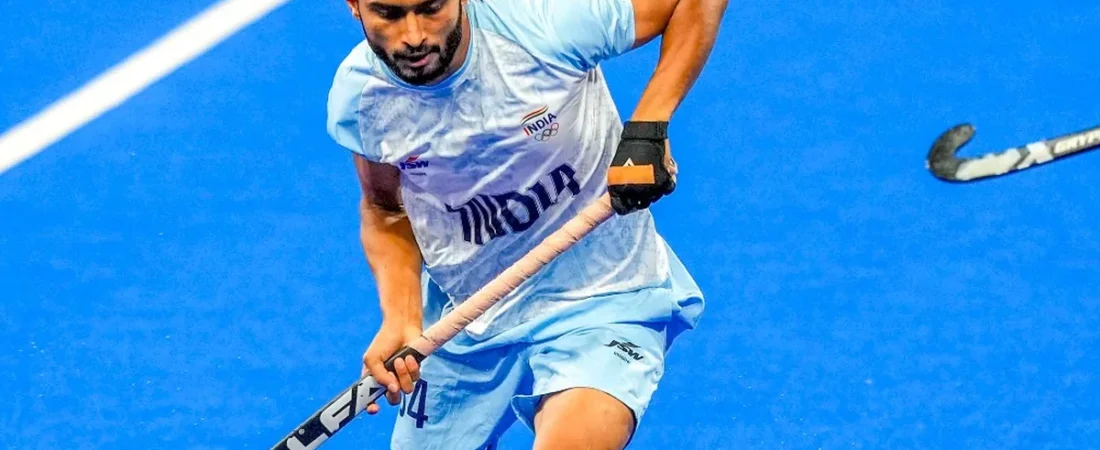
The India vs Malaysia hockey final is the match the entire Asian Games hockey tournament has been building towards. On Saturday, October 3, 2026, at 3:30 PM IST at the Gifu Prefectural Green Stadium in Kakamigahara, defending champions India and unbeaten Malaysia will collide for continental gold — and for a prize even bigger than the medal itself. The winner of the India vs Malaysia hockey final earns a direct berth at the Los Angeles 2028 Olympics, a shortcut that spares the champions the brutal qualifying tournaments and lets two full years of planning begin immediately.
India arrive chasing history. Six matches, six wins, and one semifinal classic against Pakistan that tested everything they had built. Malaysia arrive as the tournament’s most disciplined machine: five pool wins, a semifinal triumph over South Korea, and a belief that they are ready to break India’s hold on Asian hockey. This India vs Malaysia hockey final is a meeting of the continent’s two most in-form sides — and it promises to be the most tactical, most intense sixty minutes of India’s Asian Games campaign.
Match Details: Date, Time, Venue and How to Watch
Everything you need to know before the biggest game of the hockey tournament:
| Match | India vs Malaysia, Men’s Hockey Final, Asian Games 2026 |
| Date | Saturday, October 3, 2026 |
| Time | 3:30 PM IST (7:00 PM JST local) |
| Venue | Gifu Prefectural Green Stadium, Kakamigahara, Japan |
| At stake | Asian Games gold medal + direct berth at the LA 2028 Olympics |
| TV (India) | Sony Sports Network, DD Sports |
| Live streaming (India) | SonyLIV app and website |
| Bronze match | Pakistan vs South Korea, October 3, 4:30 PM IST |
The India vs Malaysia hockey final will be played under the lights at the Gifu Prefectural Green Stadium — the same ground that has hosted the tournament’s biggest moments, including India’s dramatic 4-3 semifinal win over Pakistan and the Indian women’s 1-0 gold-medal triumph over China. Hockey fans in India can follow the India vs Malaysia hockey final live from 3:30 PM IST, with television coverage expected across the Sony Sports Network channels and DD Sports, and live streaming on SonyLIV.
The bronze-medal match between Pakistan and South Korea follows at 4:30 PM IST, but make no mistake: by then, the tournament’s defining story will already have been written. The India vs Malaysia hockey final is where the gold, the Olympic ticket and the history all sit.
India vs Malaysia Hockey Final Stakes: Back-to-Back Gold and LA 2028
To understand what is at stake in the India vs Malaysia hockey final, start with the history India are chasing. No Indian team has ever won back-to-back Asian Games men’s hockey golds. India have lifted this title before — most recently in Hangzhou, where they beat Japan in the final and qualified early for Paris 2024 — but the consecutive crown has always eluded them. Harmanpreet Singh’s side can become the first Indian team to defend the continental title, and that is the kind of record that defines eras rather than tournaments.
For Harmanpreet personally, the stakes are enormous. The captain would become the first Indian captain to lead the team to two Asian Games gold medals. From the drag-flick circle to the dressing room, everything about this Indian campaign has run through him — and a second gold with his name on the trophy would place him among the great Indian hockey leaders of the modern era.
Manpreet Singh and the Three-Gold Club
There is an even rarer milestone available. Manpreet Singh, India’s most capped hockey player, was part of the 2014 gold-winning team at Incheon and the 2023 triumph at Hangzhou. A win in the India vs Malaysia hockey final would make him the only Indian ever to win three Asian Games gold medals — a record of longevity and excellence that spans more than a decade of Indian hockey’s modern rise. At 34, Manpreet remains central to India’s midfield structure: the calming presence who connects defence and attack, the player who steadies the team when finals turn chaotic. Saturday is his chance to stand alone in Indian hockey history.
The LA 2028 Olympic Berth
The biggest prize, though, is the Olympic ticket. The Asian Games champions earn a direct berth at the Los Angeles 2028 Olympics, bypassing the qualifying tournaments entirely. India walked this road after Hangzhou and it gave them a settled, two-year runway to Paris. Winning the India vs Malaysia hockey final means Craig Fulton’s programme can plan for Los Angeles from October — selection, development, experimentation — without the jeopardy of a winner-takes-all qualifier. For Malaysia, the same carrot applies: a first Olympic berth earned this way would transform their programme’s funding, status and planning.
Direct qualification matters because Olympic qualifying is unforgiving. One bad quarter in a qualifier can end a four-year cycle. Saturday’s final is effectively a pre-qualifier played as a gold-medal match — the rarest, highest-stakes kind of game hockey produces.
India’s Road: Six from Six
India’s path to the India vs Malaysia hockey final has been close to flawless, with one violent exception that made it stronger. Harmanpreet Singh’s team opened their campaign with a 13-1 demolition of Indonesia, followed by a 16-1 rout of Sri Lanka, an 8-2 statement win over South Korea, a controlled 2-0 professional performance against hosts Japan, and a 10-0 closing thrash of Bangladesh — a match in which Harmanpreet completed a hat-trick from penalty corners and the team secured top spot in Pool A with a scarcely believable +45 goal difference across the group stage.
Then came the semifinal. India raced into a 3-0 lead against Pakistan through two Harmanpreet penalty-corner conversions in the 5th and 13th minutes and a Sukhjeet Singh deflection from a Shilanand Lakra cross in the 24th. Pakistan, to their eternal credit, refused to fold: Abu Mahmood pulled one back before half-time, and in the second half Pakistan fought all the way back to 3-3 through goals from Hannan Shahid and Waheed Ashraf Rana. With 50 seconds on the clock, Abhishek’s deflected effort squeezed home for a 4-3 Indian win — the most dramatic finish of the tournament.
What the Pakistan Test Taught India
The semifinal was the best possible preparation for the India vs Malaysia hockey final. It was the first time in the entire tournament that India had faced genuine adversity: a lead surrendered, a crowd-surfing Pakistan crowd of neutrals willing them on, a green card to Dilpreet Singh that left India temporarily down to ten. And India found a way. Amit Rohidas blocked a crucial late penalty corner. Suraj Karkera stood tall in goal. Abhishek struck with ice in his veins. Champions are not made by pool-stage blowouts; they are made in the final three minutes of matches like that one. India will carry the memory of surviving October 1 into October 3 — and Malaysia, for all their discipline, have not yet been dragged into those waters.
The one cloud over India is the injury to Raj Kumar Pal, ruled out with a thumb fracture sustained against Bangladesh, with Nilakanta Sharma stepping into the squad for the semifinal. The reshuffled midfield held its shape against Pakistan’s counters, but the final is where depth gets tested most. As our preview of the India vs Pakistan semifinal noted, this fixture family is where India’s penalty-corner battery becomes the decisive weapon — and so it proved, with Harmanpreet converting twice when the pressure was highest.
Malaysia’s Road: Unbeaten, Disciplined, Fearless
If India are the favourites, Malaysia are the tournament’s most complete challengers. The Speedy Tigers topped Pool B with five straight wins — an unbeaten, professional group campaign that announced them as genuine contenders rather than dark horses. And in the semifinal, they did what finalists do: they beat South Korea, the experienced knockout campaigners, to reach the gold-medal match.
This is the crucial context for the India vs Malaysia hockey final: Malaysia have not scraped into this game. They have earned it through structure, discipline and a defensive organisation that has been the best in the tournament outside India’s. Where India’s identity is relentless attacking waves and penalty-corner volume, Malaysia’s is control — compact lines, intelligent pressing, and a counter-attack that punishes over-commitment. They are the exact kind of opponent that has historically caused India problems in finals: patient, organised, and utterly unbothered by reputations.
Why Malaysia Are More Dangerous Than Their Ranking Suggests in This India vs Malaysia Hockey Final
Malaysia’s route to the final carries a particular warning for India. South Korea, whom Malaysia beat in the semifinal, are precisely the kind of structured, physical side that India themselves have sometimes struggled to break down. Malaysia dismantled that structure with composure. They do not concede cheap goals. They do not panic when they fall behind. And they arrive at the India vs Malaysia hockey final with the confidence of a team that has beaten everyone put in front of them.
India’s pool-stage numbers were eye-catching, but Malaysia’s five pool wins came against opponents who tested their defensive discipline in ways Indonesia and Sri Lanka never could. The final will be a collision of the tournament’s best attack against its most organised defence — and that is a genuinely fascinating contest, not a coronation.
Head-to-Head: India vs Malaysia
History favours India in the India vs Malaysia hockey final fixture, and not marginally. In recent years, India have been the dominant force in this matchup across tournaments — comfortable winners on most recent meetings, with India’s drag-flick battery and pressing structure consistently too much for Malaysia’s defence to absorb over sixty minutes. The gulf in depth is real: India can rotate forwards, midfielders and defenders without losing quality; Malaysia depend on their core playing at full capacity for the whole match.
But finals reset histories. Malaysia’s players know that one performance can rewrite every trend — and they have just produced the semifinal performance to prove it. India, for their part, will draw on the lesson of October 1: a 3-0 lead evaporated against Pakistan, and the final will not forgive a similar lapse against a side as disciplined as Malaysia. The head-to-head record says India should win. The tournament form says Malaysia have earned the right to be taken very, very seriously.
The Last Meeting’s Lesson
What the recent meetings have consistently shown is that Malaysia can frustrate India in spells — their first quarter is usually excellent, their press well-drilled — but that India’s fitness, depth and set-piece power eventually tell. The question in the India vs Malaysia hockey final is whether Malaysia can stretch those frustrating spells into four quarters. If India score first and early, history suggests the floodgates open. If Malaysia are still in the game at half-time, the pressure shifts squarely onto the defending champions.
Key Players to Watch
Harmanpreet Singh (India)
The tournament’s defining individual force. Harmanpreet has 10 goals from penalty corners — second in the scoring charts behind only Pakistan’s Sufiyan Khan — and every one of them has come with intent: low, hard, and placed with a drag-flicker’s precision. His two conversions in the semifinal’s opening quarter were the platform for everything that followed. Malaysia’s corner defence will be rehearsed to exhaustion, but Harmanpreet has been converting against every system Asia has thrown at him. And with the captain’s milestone on the line — first Indian captain to two Asian Games golds — his motivation could hardly be higher.
Abhishek and Dilpreet Singh (India)
India’s forward duo have 9 goals each, and their contributions have been about much more than finishing. Abhishek’s winner with 50 seconds left against Pakistan was the defining moment of the tournament so far — a deflection of instinct and courage that saved India’s final berth. Dilpreet’s energy and movement have stretched defences throughout the tournament, even as his green card in the semifinal briefly exposed India’s discipline. In the India vs Malaysia hockey final, their runs across the circle will be India’s primary route past a compact Malaysian defence.
Manpreet Singh (India)
The heartbeat and the history-maker. India’s most capped player controls the tempo from deep midfield, and his experience in three Asian Games campaigns — gold in 2014 and 2023 — is the institutional memory this team leans on in finals. If Malaysia’s press disrupts India’s rhythm, Manpreet is the player who re-establishes it.
Malaysia’s Counter-Attack
Malaysia’s greatest threat is collective rather than individual: the speed and precision of their transition. When India’s attacking full-backs push high — as they will — Malaysia’s forwards will look to exploit the space behind with the kind of rapid vertical hockey that undid South Korea in the semifinal. India’s defence, marshalled by Amit Rohidas and goalkeeper Suraj Karkera, must be alive to the turnover all evening.
Suraj Karkera (India)
Goalkeepers win finals. Karkera’s saves in the semifinal’s closing stages — standing tall when Pakistan threw everything forward — were as decisive as Abhishek’s winner. Malaysia will get chances; counter-attacking sides always do. Karkera’s duel with their finishers may decide the India vs Malaysia hockey final as much as anything that happens in India’s circle.
The Tactical Battle That Will Decide the Final
The India vs Malaysia hockey final will be won or lost in three zones. First: the penalty corners. India’s conversion rate, powered by Harmanpreet and a battery of variations behind him, has been the tournament’s most reliable scoring mechanism — and Malaysia, like every opponent, know it. Expect Malaysia to defend the circle desperately, with the first runner charging and the goalkeeper organising. But India’s volume of corners has been overwhelming: even a good Malaysian defensive routine will crack if India keep earning set-pieces. The opening ten minutes will tell us everything — if Harmanpreet converts early, Malaysia’s game plan collapses.
Second: the midfield tempo. India’s structure under Craig Fulton is built on control — high press, quick ball circulation, full-backs stepping into midfield, forwards rotating to drag markers out of shape. Malaysia will try to fragment that rhythm: a compact block, a low press that springs near halfway, and immediate vertical balls when possession turns over. Every free hit becomes an attempt to slow India’s momentum. India must be patient without being passive, the way they were in the 2-0 pool win over Japan — the template performance of their tournament.
Third: the transition war. Both teams counter-attack brilliantly, which means both will be wary of over-committing. India’s full-backs love to overlap; Malaysia’s forwards love the space that creates. This is where Manpreet’s positioning and Nilakanta Sharma’s discipline in the reshuffled midfield become critical. The India vs Malaysia hockey final could easily turn on a single turnover — a stolen ball in midfield, one clean pass, one deflection at the far post.
Discipline, Again
India’s green card to Dilpreet in the semifinal nearly cost them dearly — Pakistan capitalised during those two minutes to start their comeback. Against a side as clinical on the break as Malaysia, a carded suspension could be fatal. Fulton’s side must channel their aggression legally: hard tackles, legal tackles, and the emotional control of champions. Finals punish indiscipline faster than any other stage.
India vs Malaysia Hockey Final Prediction
Prediction (not a result — the match is yet to be played): India start as clear favourites in the India vs Malaysia hockey final, and the reasoning is straightforward: six wins from six, the tournament’s most potent attack, the best drag-flicker in Asia, a captain with history on the line, and the psychological armour of having survived the semifinal of the year against Pakistan. Our prediction is an India win by two goals — something in the region of 3-1 or 4-2 — with Harmanpreet Singh converting at least once from a penalty corner and the forwards adding goals from open play.
But this is a final, and finals have their own gravity. Malaysia’s unbeaten record is not an accident: five pool wins and a semifinal win over South Korea is the resume of a team that knows exactly what it is. If Malaysia score first — and their counter-attack is capable of producing one — the India vs Malaysia hockey final becomes a test of Indian nerve that the Pakistan semifinal only previewed. The lesson of October 1 is that no lead is safe; the lesson Malaysia will carry is that India can be rattled.
The most likely script is an India fast start: early penalty corners, Harmanpreet striking, the Malaysian block cracking under volume. From there, champions manage games — and India, unbeaten and battle-tested, have shown they can. Whatever happens, the winner leaves Kakamigahara with gold and the first ticket to Los Angeles 2028. It does not get bigger than that.
The context of these Games only raises the stakes. India’s campaign has already delivered landmark moments — the women’s team ending their 44-year wait with gold against China, and the medal tally climbing past 60. A men’s hockey gold, back-to-back and Olympic-qualified, would crown it all. For tactical context on Malaysia’s challenge, Khelnow’s India vs Malaysia preview breaks down the final’s key battles, while their report on the India vs Pakistan semifinal relives Thursday’s classic, and Sporting News’ India hockey hub tracks the squad’s full tournament run.
Why this story matters: The India vs Malaysia hockey final is India’s first-ever shot at back-to-back Asian Games golds, Harmanpreet’s chance to become the first captain with two titles, Manpreet’s shot at an unmatched third gold — and a direct ticket to Los Angeles 2028 for whoever wins. One game, sixty minutes, and history on every blade of grass.