
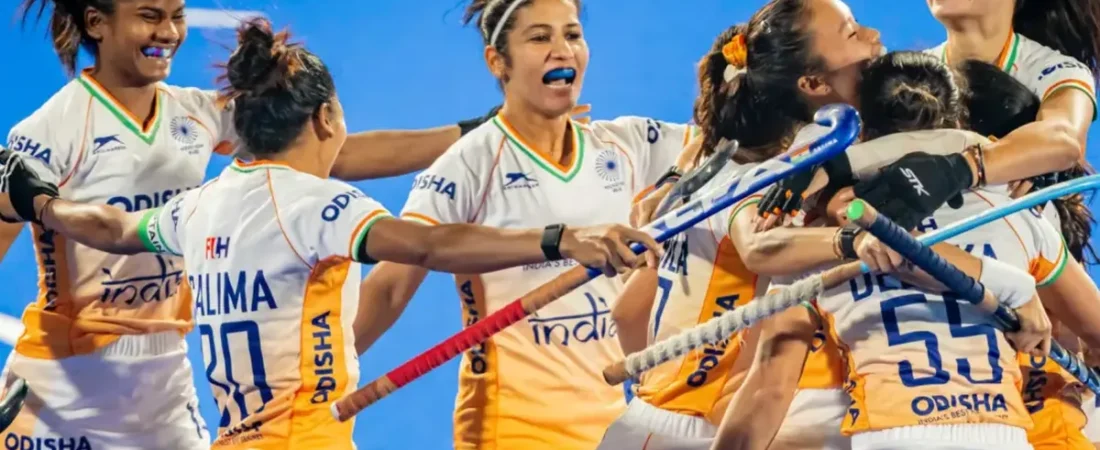
Forty-four years. That is how long Indian women’s hockey has waited for a night like the one coming on October 2 in Kakamigahara. The India women’s hockey Asian Games final is set, and it carries the weight of every generation since 1982: an unbeaten Indian side, marshalled by captain Salima Tete, against defending champions China — the team that has so often stood between India and gold, and the team this squad now genuinely believes it can beat. India ground out a 2-0 semifinal win over a stubborn South Korea on Wednesday, and in doing so reached their fourth Asian Games final. One match now separates them from ending the longest gold drought in Indian hockey.
This preview of the India women’s hockey Asian Games final is also a story about patience — on the pitch, where India needed 44 minutes to break down Korea, and across history, where 44 years have passed since the last gold. Both waits end, one way or another, under the lights in Kakamigahara.
In this story:
- The Semifinal That Refused to Open
- Three Minutes That Broke the Wall
- The India Women’s Hockey Asian Games Final and a 44-Year Shadow
- China Await: Champions With Cracks
- How India Can Win the India Women’s Hockey Asian Games Final
- One Final in a Golden Indian Week
The Semifinal That Refused to Open
Semifinals are supposed to be tense. They are not supposed to feel like this. For 44 minutes at the Gifu Prefectural Green Stadium in Kakamigahara on September 30, India played the hockey of a team in total control — and had absolutely nothing to show for it. South Korea, ranked 15th in the world and beaten in all four previous meetings with this Indian side, defended as if the semifinal itself were their gold medal match. The first half ended goalless, and the longer the deadlock lasted, the more the pressure on the world No. 8 side grew.
India had become accustomed to double-digit blowouts in the group stage, matches where the goals flowed early and the questions were about rotation and rest. Knockout hockey is a different sport. Korea sat deep, protected the circle with disciplined numbers, and trusted their goalkeeper to handle the rest. It very nearly worked. India dominated possession and territory for long stretches, pinned Korea back through both quarters of the first half, and yet walked into the interval at 0-0, with the semifinal slowly turning into the kind of trap that has ended Indian campaigns before.
Nine Penalty Corners, Zero Goals
The statistic that defined the first half was stark: India earned nine penalty corners and converted none of them. Nine. In modern hockey, penalty corners are the currency of knockout matches, the set-piece from which tight games are supposed to be unlocked. India kept winning them and kept wasting them, each failed conversion adding a layer of tension to the next. Navneet Kaur came closest from open play and from the top of the circle alike — one powerful strike drew a superb save from the Korean goalkeeper, who stretched across her goal to keep the scores level. Lalremsiami, too, could not finish after being slipped through by a fine Navneet pass.
Forwards dream of semifinals; this one was becoming a nightmare measured in missed chances. Every unconverted corner invited the thought Indian fans know too well: dominate, miss, concede, regret. Korea even threatened in flashes on the counter, testing India’s defence from both flanks, but the Indian back line stayed organised and calm even as the attack grew frantic.
Seoyeon Lee and the Art of Frustration
If one player nearly rewrote this semifinal, it was South Korea’s goalkeeper Seoyeon Lee. Outstanding throughout the first half, she read drag-flicks early, closed angles quickly and refused to be beaten by anything India constructed. Goalkeepers feed on exactly this kind of match — a favourite camped in front of them, a crowd sensing inevitability, and a save counter climbing save by save. Lee’s performance forced India into the hardest discipline in sport: patience. Coach Sjoerd Marijne’s side had to keep believing the breakthrough would come without forcing the play that produces mistakes.
The goalless first half was, in its own way, a useful warning. Finals are rarely won in the first quarter. India had learned, the hard way and in real time, how to keep playing their game when the scoreboard refused to cooperate. That lesson would matter within minutes of the restart.
Three Minutes That Broke the Wall
When the breakthrough finally arrived, it came not from a thunderbolt but from a variation — the kind of detail that separates well-coached teams from hopeful ones. In the 44th minute, India finally converted a penalty corner, with Ishika Chaudhary applying the decisive touch to a set-piece variation and Deepika Sehrawat providing the assist, as reported by Revsportz. After nine failures, the tenth plan worked. The relief around the Indian bench was visible: this was the goal that changed the shape of the semifinal, forcing Korea to abandon the low block that had frustrated India for three quarters.
Three minutes later, the semifinal was effectively settled. Captain Salima Tete drove down the right flank and found the net in the 47th minute to double the lead — a goal the captain was credited with, even as some reports suggested a deflection off a Korean stick may have helped it on its way. Either way, it was fitting. Captains are supposed to appear when matches tilt, and Salima’s surge down the flank, at the precise moment Korea were stretched between protecting a one-goal deficit and chasing an equaliser, was the act of a leader who had felt the game turning and seized it.
The final quarter became an exercise in game management. India, unbeaten through the tournament, protected their 2-0 lead with the composure that had been missing from earlier knockout exits. A medal was assured. More importantly, the manner of the win — patience rewarded, set-piece problem solved, captain stepping forward — felt like exactly the rehearsal a team needs before a final against the defending champions.
The India Women’s Hockey Asian Games Final and a 44-Year Shadow
To understand why the India women’s hockey Asian Games final matters so much, you have to go back to 1982. That was the year India’s women won their only Asian Games hockey gold — a first-place finish from an era when Indian hockey, men’s and women’s alike, still carried the aura of its Olympic golden age. In the 44 years since, the women’s team has reached finals, won silvers, produced heroic Olympic runs and world-class players, but the Asian Games gold has never come home again. Three previous finals ended in silver. The fourth final, on October 2, offers the chance to close the longest-running story in Indian team sport.
Consider what 44 years contains. Entire careers have begun and ended inside that wait — players who won medals at World Cups and Olympics, captains who lifted Asian Champions Trophies, all without the one continental crown that has eluded the programme since 1982. The current squad knows the number by heart; it has been part of their motivational furniture all tournament. Salima Tete’s team arrives at the final unbeaten, which matters psychologically: this is not a side sneaking into a title match on shootout luck. It is a side that has won every test put in front of it, including the semifinal that tried to suffocate it.
There is a broader resonance too. Indian women’s hockey has lived, for decades, in the long shadow of the men’s game — fighting for funding, visibility and belief. The famous fourth-place finish at the Tokyo Olympics began to change that story in the public imagination. An Asian Games gold, 44 years after the last one, would complete the argument: that the women’s programme is not a heartwarming subplot of Indian hockey but one of its central achievements. For a generation of young players watching in Jharkhand, Odisha and Haryana, October 2 is about far more than one medal.
China Await: Champions With Cracks
Standing in India’s way are the defending champions, and there is no softening that fact. China, ranked fourth in the world, remain the benchmark of Asian women’s hockey — structured, powerful and ruthlessly organised under legendary Australian coach Alyson Annan, one of the most decorated figures the sport has produced. Captain Ou Zixia anchors a side that knows exactly how to manage tournament hockey, and China’s route to this final showed both their strength and, intriguingly, their vulnerability.
What Japan Exposed
China’s semifinal should give India genuine encouragement. Held 0-0 by hosts Japan through regulation time, the defending champions needed a shootout to advance, winning it 4-2. A team of China’s quality being shut out for a full match is a significant data point: they can be contained, their attack can be blunted by disciplined, deep defending, and the aura of inevitability that surrounds them is thinner than the rankings suggest. Japan nearly provided the blueprint for beating them. India, with a stronger attacking unit, will study that semifinal closely.
The Annan Factor — and the 4-0 Scar
And yet. India carry a specific scar into this final. The last time these teams met at the Asian Games, in the Hangzhou semifinal, China beat India 4-0 — a defeat comprehensive enough to end the gold dream in an afternoon. Alyson Annan’s sides are masters of the big occasion, and she will have noted every one of India’s nine unconverted penalty corners against Korea. The counterweight is more recent: the last meeting between the sides at the World Cup ended in a draw, evidence that the gulf has closed to something India can cross on their best day. The 4-0 is history. The draw is trend. Finals are decided by which version of a rivalry shows up — and this Indian team, unbeaten and battle-tested by the Korean wall, has reasons to believe the trend is theirs.
How India Can Win the India Women’s Hockey Asian Games Final
Strip away the emotion of the 44-year wait, and the India women’s hockey Asian Games final reduces to a handful of concrete battles. First: penalty corners. Nine unconverted corners against Korea would be fatal against China, who will not allow India that many looks at goal. The variation that finally unlocked Korea — Ishika Chaudhary finishing, Deepika Sehrawat creating — must become a reliable weapon rather than a late improvisation. Against Annan’s defence, India may get four or five corners. Converting one could decide the gold.
Second: patience without passivity. China, like Korea, are content to defend deep and strike on transitions, but they carry far more attacking threat when they break. India must reproduce the semifinal’s defensive discipline — the organised back line that gave Korea nothing — while avoiding the frantic final passes that crept in during the goalless first half. Third: the captain. Salima Tete’s semifinal goal was a reminder that India’s biggest moments in this tournament have come when their leader has taken responsibility personally. China will plan for her runs down the right; India’s supporting attackers must exploit the space that attention creates.
Finally, there is the shootout question. China have already survived one in this tournament, which cuts both ways: they are practised, but they have also shown they can be dragged there. If the final is level late, India’s unbeaten composure — four quarters of it against Korea — becomes their most valuable asset. The 44-year wait will not win this match. Composure, conversion and one captain’s courage might.
One Final in a Golden Indian Week
The hockey final lands in the middle of one of the great weeks of India’s Asian Games campaign. The kabaddi teams have already delivered a double gold, with both the men’s and women’s teams beating Iran in their finals to continue India’s dominance of the sport it gave the world. On the athletics track, the javelin produced a South Asian sweep and a reminder of shifting hierarchies, as Sri Lanka’s Rumesh Pathirage took the gold India never got to defend in Neeraj Chopra’s absence. Match reports from the hockey semifinal, including Deccan Herald’s account of the 2-0 win over South Korea and IANS’s report on India’s route to the final, underline how hard-earned this title shot was.
That context matters. Kabaddi’s golds were expected; hockey’s, if it comes, would be a heist 44 years in the planning, against the defending champions, on the biggest continental stage. It would rank among the defining Indian sporting moments of these Games.
On October 2, under the lights in Kakamigahara, an unbeaten team led by Salima Tete walks into the India women’s hockey Asian Games final with history on one side of the pitch and destiny on the other. Forty-four years ago, Indian women stood on top of this podium. Everything since has been the long climb back. Friday is where the climb ends — one way or the other.
Why this story matters: The India women’s hockey Asian Games final is a 44-year wait meeting its best-ever chance — an unbeaten team, a captain in form, and defending champions who have finally shown cracks.