
The India vs Pakistan Asian Games 2026 story is one Indian sport will tell for decades, because the most famous rivalry in Asian sport delivered a script that no screenwriter could have improved. Across three days at Aichi-Nagoya 2026, India’s men met Pakistan twice — in the men’s hockey semifinal on October 1 and in the men’s cricket final on October 3 — and won both. A 4-3 hockey epic in Nagoya, sealed with 49.2 seconds left on the clock, was followed by a 19-run cricket triumph in Okazaki, where India defended 211 against a lone Pakistani assault. Two sports, two victories, one unforgettable week in the India vs Pakistan Asian Games 2026 saga.
What made the India vs Pakistan Asian Games 2026 double so special was not just the results but the manner of them. Neither win was routine. Both arrived with late drama that tested nerves and revealed character: a deflection with under a minute remaining in hockey, and a high-pressure defence of a gettable total against a batter in unstoppable form in cricket. This is the story of how India won the India vs Pakistan Asian Games 2026 battle twice — and what it says about the two programmes’ very different directions.
India vs Pakistan Asian Games 2026: The 4-3 Hockey Epic in Nagoya
Of all the matches played across the India vs Pakistan Asian Games 2026 rivalry, few will be remembered as vividly as the men’s hockey semifinal on October 1. India, the defending champions, against Pakistan, the wounded giants of Asian hockey. Ninety seconds of chaos, a three-goal lead surrendered, and then a winner struck with 49.2 seconds left. If you were writing a preview of the India vs Pakistan Asian Games 2026 hockey clash — as we did, breaking down the date, time, venue and tactical battle beforehand — you could not have scripted what actually happened at the Gifu Prefectural Green Stadium in Nagoya.
Harmanpreet’s first half sets the tone
India came out like a team that intended to end the contest early. Captain Harmanpreet Singh, the most feared drag-flicker in world hockey, broke the deadlock in the 5th minute from a penalty corner, and doubled the lead in the 13th minute from another set piece. Pakistan, who had started with intent, suddenly found themselves chasing the game and chasing shadows. India earned corners at will in the opening quarter, and the gulf in the drag-flick batteries of the two sides was impossible to miss.
The third goal arrived in the 24th minute and was a thing of beauty. Shilanand Lakra, one of the breakout forwards of India’s campaign, burst down the left and squared the ball for Sukhjeet Singh to deflect home. At 3-0, with the structure of the match firmly in India’s hands, the India vs Pakistan Asian Games 2026 hockey semifinal looked like it was heading the way of Hangzhou — towards a rout rather than a contest. India’s press was suffocating, their circle entries numbered far beyond Pakistan’s, and the favourites were playing the fast, controlled hockey that had carried them unbeaten through the pool stage.
Pakistan’s astonishing comeback
Then came the reminder of why this fixture is never over until it is over. Just before half-time, Pakistan pulled one back through Abu Mahmood’s penalty corner in the 30th minute — a goal that carried a touch of fortune but gave the green shirts something priceless: belief. In the second half, with Dilpreet Singh serving a green-card suspension, Pakistan struck twice more. Hannan Shahid made it 3-2 in the 45th minute, and Waheed Ashraf Rana completed the comeback in the 49th minute to level the match at 3-3.
The momentum had swung completely. Pakistan, written off at 3-0, were now the side with the energy, the noise, and the destiny. India’s unbeaten run, their title defence, and their direct route to the LA 2028 Olympics all hung in the balance. This was the moment that separated a good team from a championship team — and India, to their immense credit, refused to panic.
The 49.2-second winner
What happened next will be replayed for years. With the clock bleeding down and the match seemingly destined for a shootout, India threw everything forward one last time. The ball broke loose in a crowded Pakistani circle, and Abhishek — the forward who had been quiet for much of the evening — struck it goalwards. The shot took a deflection off Sufiyan’s stick and wrong-footed the goalkeeper. The stadium erupted. With 49.2 seconds remaining, India led 4-3.
There were no further slip-ups. India held their shape, killed the clock, and sealed their place in the final against Malaysia on October 3 at 3:30 PM IST. The India vs Pakistan Asian Games 2026 hockey semifinal had delivered everything the rivalry promises: quality, chaos, heartbreak for one side and ecstasy for the other. As Khelnow’s match report captured, it was a semifinal that swung from Indian dominance to a Pakistani fightback and finally to last-gasp Indian relief.
India vs Pakistan Asian Games 2026: The 19-Run Cricket Final in Okazaki
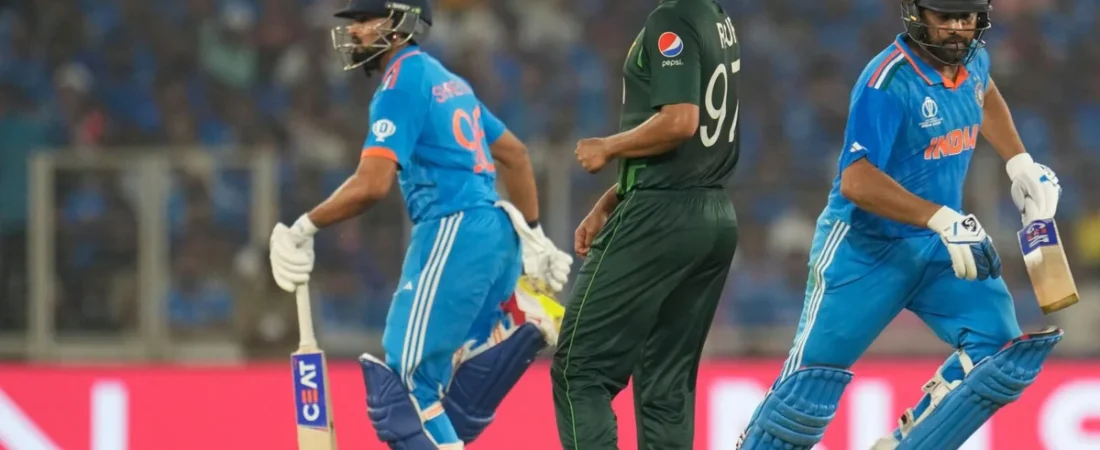
If the hockey semifinal was an epic, the India vs Pakistan Asian Games 2026 cricket final was a thriller of a different kind. Played on October 3 at the Korogi Sports Park in Okazaki, it was the first-ever meeting between the two nations in Asian Games cricket — a historic occasion in itself — and it ended with India defending their Hangzhou 2023 gold with a 19-run victory. India posted 211 for 6, and Pakistan, chasing, were held to 192 for 6. In the context of the India vs Pakistan Asian Games 2026 rivalry, it was the perfect sequel to the hockey drama: another win, another test of nerve, another gold defended.
Abhishek and Tilak set the platform
India’s innings was built on fearless, modern T20 batting. Abhishek Sharma, who had been one of the stories of India’s tournament, smashed 61 off just 28 balls at the top of the order, setting a tempo that Pakistan’s bowlers never recovered from. His innings was all timing and audacity — the kind of powerplay assault that defines big finals. When he departed, Tilak Varma took over the mantle of aggressor-in-chief, finishing unbeaten on 51 from 22 balls to carry India past 200.
The total of 211 for 6 was imposing but not impregnable — a score that demanded scoreboard pressure rather than complacency. India’s batters had done their job; now it was over to the bowlers. And the bowlers, as it turned out, would need every run, because Pakistan had a plan of their own.
Hasan Nawaz’s lone assault
Pakistan’s chase revolved around one man. Hasan Nawaz produced an innings of rare quality under the most intense pressure imaginable, smashing 96 off 51 balls to keep Pakistan in the hunt deep into the chase. Every time India threatened to pull away, Nawaz found the boundary. Every time the required rate climbed, he answered. It was the kind of knock that wins finals — except that, on this day, it was not quite enough.
The problem for Pakistan was the lack of support. While Nawaz raged at one end, wickets fell and partners came and went at the other. India’s bowlers, rather than panicking at the sight of a set batter, stuck to their plans with admirable discipline. Axar Patel returned 2 for 29, Washington Sundar matched him with 2 for 29, and Shivam Dube’s 2 for 33 broke the back of the middle order. The three-pronged spin and seam squeeze meant that even as Nawaz attacked, the equation kept drifting away from Pakistan.
Defending 211, defending the gold
The final overs were a masterclass in pressure bowling. India defended the total with the calm of a side that has been here before — because, at Hangzhou 2023, they had. When Pakistan finished on 192 for 6, 19 runs short, India’s players celebrated a gold medal that was about far more than one match. As reports of the cricket final noted, it was the defence of a title, the winning of the first-ever India-Pakistan Asian Games cricket final, and the completion of a sporting double that will live long in the memory. Sporting News’ build-up to the gold-medal match had framed it as a historic first meeting — and the final lived up to every bit of that billing.
Taken together, the two results of the India vs Pakistan Asian Games 2026 week tell a remarkable story. India beat Pakistan 4-3 in a hockey semifinal for the ages, then beat them by 19 runs in a cricket final for the history books. Two sports, two finals-weekend matches, two Indian victories — and both secured with late-game nerve.
The History Behind the Rivalry
To understand the weight of the India vs Pakistan Asian Games 2026 double, you have to understand the history it sits on. This is not a normal sporting rivalry. Together, India and Pakistan account for eleven Olympic gold medals in hockey — a shared heritage that no other fixture in world hockey can touch. For decades, the Asian Games hockey final was practically reserved for them. The badge both teams wear carries the weight of that history, and every meeting is played in its long shadow.
Pakistan’s eight golds and India’s resurgence
Pakistan remain the most successful team in Asian Games hockey history, with eight gold medals — a record that speaks to an era of dominance that older fans remember vividly. But the recent chapter of the rivalry has belonged overwhelmingly to India. At Hangzhou 2023, India demolished Pakistan 10-2 in the pool stage — the heaviest defeat Pakistan have ever suffered in this fixture. That scoreline was not just a result; it was a statement about the divergent paths of the two programmes.
The India vs Pakistan Asian Games 2026 results confirm that the statement still stands, even if the margins have narrowed. A 4-3 semifinal win and a 19-run cricket final victory are not 10-2 routs — Pakistan fought with genuine courage in both — but they are wins all the same. And in rivalry terms, the scoreboard is the only history that matters.
Why this fixture stops two nations
There is a reason the India vs Pakistan Asian Games 2026 clashes drew the biggest audiences of the Games. In both countries, this fixture transcends sport. It is about pride, identity and the oldest sporting argument on the subcontinent. Players on both sides speak of the unique pressure — the noise, the expectation, the knowledge that millions are watching every touch. That India held their nerve in both encounters, in the final minutes of both, says something profound about the mental strength of this generation of Indian athletes.
Two Programmes, Two Directions
The deepest story of the India vs Pakistan Asian Games 2026 double is not about two matches. It is about two programmes heading in opposite directions — and about what separates them. Analysis, not celebration, is where the real insight lies, because the scoreboard flatters a complexity worth understanding.
India’s professionalised machine
India’s victories at these Games were built on systems, not moments. The hockey team arrived with a professional structure: a world-class drag-flick battery led by Harmanpreet Singh, a deep pool of forwards, sports-science support, and a squad that has played finals together for years. The cricket team, drawn from the deepest T20 talent pool on the planet, played with the freedom of athletes who have faced pressure in front of packed stadiums since their teens.
This is the pattern across Indian sport at Aichi-Nagoya. As our analysis of India’s final 81-medal tally showed, India’s golds have come from ecosystems — professional leagues, international exposure, and athletes who treat finals as familiar territory. The India vs Pakistan Asian Games 2026 wins fit that pattern perfectly: India did not just have better players on the day; they had a better machine behind them.
Pakistan’s courage, Pakistan’s struggle
None of this diminishes Pakistan. Their comeback from 3-0 down in the hockey semifinal was magnificent — a display of heart that reminded everyone why this fixture matters. Hasan Nawaz’s 96 in the cricket final was an innings of genuine world-class quality. Pakistan’s athletes continue to produce moments of brilliance that belie the state of the systems behind them.
But the divergence is real. Pakistan’s hockey programme has battled funding crises, administrative turmoil and a shrinking domestic base for years. Their cricket, while still producing extraordinary individual talent, lacks the depth of India’s production line. The India vs Pakistan Asian Games 2026 story is, at its core, the story of what happens when one nation’s sporting infrastructure matures while the other’s stagnates. Courage can win quarters; systems win tournaments.
The 49.2 seconds and the 19 runs
There is a final symmetry worth savouring. Both of India’s wins in the India vs Pakistan Asian Games 2026 week were sealed late — a winner with 49.2 seconds left in hockey, and a 19-run defence completed in the final overs in cricket. In both cases, India were tested at the exact moment when lesser teams fold. In both cases, they found a way. That is not luck. That is what professionalised, battle-hardened teams do.
The Wider Picture at Aichi-Nagoya
The India vs Pakistan Asian Games 2026 double did not happen in isolation. It was the headline act of a Games in which Indian sport announced itself as a genuine multi-sport power. The numbers tell the story: India finished with 81 medals, a haul built on depth across shooting, athletics, archery, kabaddi, boxing, wrestling and more.
The week also belonged to India’s women. The women’s cricket team had already won gold earlier in the tournament, beating Sri Lanka in the final to defend their title. And on October 2, between the two men’s triumphs over Pakistan, India’s women’s hockey team produced one of the great results in the nation’s sporting history — beating China 1-0 in the final to end a 44-year wait for Asian Games gold. The distinction matters: the women’s hockey gold came against China, not Pakistan, but it belonged to the same golden week as the India vs Pakistan Asian Games 2026 double.
It was also a week of individual brilliance that Indian fans will remember alongside the team triumphs. From Shubman Gill’s record-breaking 223 not out in the ODI series against West Indies to the compound archers’ clean sweep and the wrestlers’ late medals, Aichi-Nagoya 2026 was a Games where Indian athletes repeatedly delivered on the biggest stages. The India vs Pakistan Asian Games 2026 victories were the emotional peak of a much broader story.
What the Double Means for Indian Sport
So what does the India vs Pakistan Asian Games 2026 double actually mean? In the short term, it means gold medals defended, a hockey final reached against Malaysia, and a week of national celebration. In the longer term, it means something more valuable: proof that India’s sporting systems are now producing athletes who win the matches that matter most, against the opponents that matter most, in the moments that matter most.
Rivalries are the truest tests in sport, because they strip away everything except character. Across the India vs Pakistan Asian Games 2026 week, India passed that test twice — in Nagoya, with 49.2 seconds on the clock, and in Okazaki, defending 211 against a rampaging Hasan Nawaz. Two wins in three days. The rivalry, for now, is silent. And Indian sport has never looked stronger.
Why this story matters: The India vs Pakistan Asian Games 2026 double — a 4-3 hockey semifinal sealed with 49.2 seconds left and a 19-run cricket final triumph — was the perfect distillation of where the two programmes stand: India’s professionalised systems producing champions who hold their nerve, and a rivalry that, for now, has been emphatically settled.