
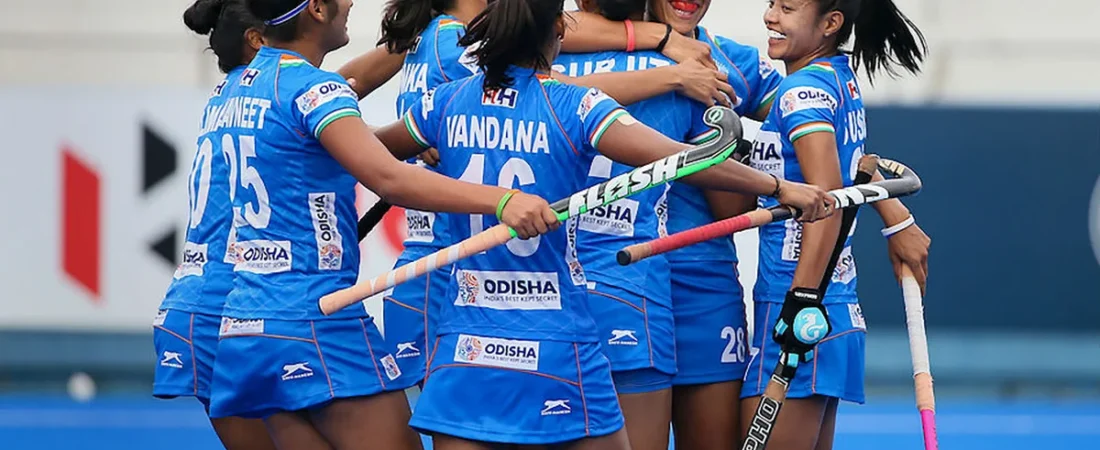
There are results you read about, and there are results you feel in your bones. On October 2, 2026, at the Gifu Prefectural Green Stadium in Kakamigahara, India women beat China hockey gold rivals 1-0 in the Asian Games 2026 women’s final — and a wait of 44 years came to an end.
One goal. A lofted tomahawk from Lalremsiami in the 10th minute. One penalty-stroke save from Savita Punia in the 22nd minute. Then sixty minutes of courage against the defending champions — the Olympic silver medallists, the world No. 4 side coached by Alyson Annan — before the hooter confirmed that India were Asian Games hockey champions for only the second time in history, the first since New Delhi 1982. This is the complete story of how India women beat China hockey gold at Aichi-Nagoya 2026.
The significance of India women beat China hockey gold goes far beyond one evening in Japan. The victory secured a direct berth at the Los Angeles 2028 Olympics, turning continental glory into an Olympic ticket in a single night. It redeemed the silvers of 1998 and 2018. It rewarded a squad that stayed unbeaten through the tournament and refused to bend when the defending champions threw everything at them. For Indian hockey, this is a landmark that will be talked about for decades.
In this story:
- The Night India Women Beat China Hockey Gold: 1-0 in Kakamigahara
- Lalremsiami’s 10th-Minute Tomahawk
- Savita Punia’s Penalty-Stroke Save
- The Defensive Wall That Guarded the Gold
- 44 Years: The Weight Behind the Gold
- Tactics: How India Women Beat China to Hockey Gold
- Savita Punia: A Legacy Sealed
- Lalremsiami: 200 Caps, One Golden Goal
- Direct to LA 2028: What the Gold Unlocks
- A Golden Week for Indian Sport
- What Comes Next for Indian Women’s Hockey
The Night India Women Beat China Hockey Gold: 1-0 in Kakamigahara
Even before the first whistle, the final carried the weight of history. The match had been delayed by about an hour after the team buses were caught in traffic on the way to the stadium, eventually starting at around 4:30 PM IST. By the time the players walked out at the Gifu Prefectural Green Stadium, the tension was already thick — India chasing a first women’s hockey gold since 1982, China defending the title they had won as champions.
China, coached by the legendary Alyson Annan, arrived as the Olympic silver medallists and the world No. 4 side. They were the favourites on paper, a team built to control finals through structure, pressing and set-pieces. India arrived unbeaten, battle-tested by a stubborn South Korean side in the semifinal, and carrying the belief of a team that had grown with every match. The stage was set for the kind of final that defines generations — and that is exactly what happened when India women beat China hockey gold in a 1-0 classic.
The pattern of the evening was established early. China tried to take an aggressive start, pressing high and looking to impose themselves on the contest. India’s defence, marshalled superbly, held its shape. Then, against the run of play in the opening quarter, came the moment that decided the final. In the 10th minute, Sakshi Rana slipped a pass inside the circle and Lalremsiami met it with a stupendous lofted tomahawk — a reverse-stick finish of rare quality — that flew into the back of the Chinese net. India led 1-0, and the 44-year dream was suddenly alive.
What followed was a masterclass in defending a lead. China dominated possession for large periods, China won penalty corners, China were even awarded a penalty stroke — and India, somehow, held them all off. The Chinese kept coming in waves through the second and third quarters, attacking down the flanks and forcing India’s deep defence to work overtime. But the Indian circle became a fortress, and the players threw their bodies on the line for the cause. By the time the hooter sounded, India women beat China hockey gold rivals by the finest of margins, 1-0, and the celebrations could begin.
Lalremsiami’s 10th-Minute Tomahawk
Great finals are often decided by a single moment of brilliance, and this one was no exception. The goal that won India the gold was worthy of the occasion and of the 44-year wait it ended. Sakshi Rana found Lalremsiami inside the circle, and the forward turned and unleashed a lofted tomahawk that beat the Chinese goalkeeper and nestled into the corner of the net.
The tomahawk — a reverse-stick shot struck with the back of the stick — is one of the hardest skills in hockey to execute under pressure. It requires perfect timing, a clean pick-up and the confidence to attempt the spectacular when the safe option is available. Lalremsiami had all three. Her finish was described as stupendous, and it was the kind of goal that will be replayed for years whenever the story of India women beat China hockey gold is told.
There was a personal milestone wrapped inside the team triumph. The final was Lalremsiami’s 200th appearance for India — a landmark of longevity and consistency at the highest level. To mark your 200th cap with the goal that wins an Asian Games gold after 44 years is the stuff of sporting fairy tales. Few players in Indian hockey history can claim a more perfectly timed contribution.
India had other chances too. Off an Indian penalty corner in the 13th minute, Navneet Kaur’s slap shot flew into the Chinese circle, but Ishika Chaudhary and Sunelita Toppo were unable to get the decisive deflection. It did not matter in the end. One goal was enough — one moment of brilliance, converted at exactly the right time, to give India the lead they would never surrender. It was the moment that made India women beat China hockey gold a reality.
Savita Punia’s Penalty-Stroke Save
If Lalremsiami’s goal was the moment India seized the final, Savita Punia’s save was the moment India refused to let it go. In the 22nd minute, with China pressing hard for an equaliser, the defending champions were awarded a penalty stroke — the most dangerous scoring opportunity in hockey, a one-on-one from the spot with only the goalkeeper to beat.
Zhang Ying stepped up for China. Savita Punia stood her ground, read the flick, and dived low to her left to make a stunning stop. It was the defining intervention on the night India women beat China hockey gold. It was the save of the match, a moment of pure goalkeeping excellence at the exact instant India needed it most. The 1-0 lead survived, and the momentum of the final swung decisively back towards the team in blue.
The save was emblematic of Savita’s entire evening. Throughout the high-stakes encounter, the Indian goalkeeper held firm against continuous pressure from the Chinese attack, organising her defence and pulling off crucial interventions. China kept entering the circle with intent and purpose, especially in the second and third quarters, but Savita stood unbeatable between the sticks. When the defining moment of India women beat China hockey gold is discussed, her penalty-stroke save will be remembered alongside the goal that won it — the two moments that defined how India women beat China hockey gold.
Goalkeepers win finals as surely as goalscorers do, and Savita’s performance was that of one of the best in the world at the peak of her powers. The penalty stroke came at a moment when China were on top — an equaliser then would have changed the entire complexion of the final. Instead, the save preserved the lead, lifted the entire Indian team, and left the defending champions wondering what more they had to do.
The Defensive Wall That Guarded the Gold
Behind every 1-0 victory in a major final lies a defensive performance of extraordinary discipline, and this was no different. India’s back line, tested relentlessly by the Olympic silver medallists, produced one of the great rearguard displays in Indian hockey history on the night India women beat China hockey gold.
The goal-line clearances told the story. In the 19th minute, Navneet Kaur cleared one off the line to deny China an equaliser. Later, Shilpi Dabas made another goal-line clearance, throwing herself into the path of danger to keep the ball out. These were not routine defensive actions — they were acts of desperation and courage, the kind that win gold medals. They were the actions that ensured India women beat China hockey gold.
Shilpi Dabas played an outstanding role in the Indian circle, working tirelessly as China dominated possession for long stretches. The Chinese attack came in waves, probing down the flanks and winning penalty corners, but the Indian deep defence made amends time and again. Every player gave her body for the cause, defending the slim 1-0 lead with a desperation that grew more intense with every passing minute.
There was a cost. Midfielder Salima Tete, the captain, went off for treatment after running down Chinese drag-flicks — a sacrifice that summed up India’s evening. She had thrown herself into the defensive effort with everything she had, and her absence was felt. But the wall held. In the closing minutes, China pulled goalkeeper Liu Ping for an extra outfield player, throwing the absolute kitchen sink at India. The defence stood firm, the ball was cleared, the clock ran down, and India women beat China hockey gold with a defensive display for the ages.
India finished the match with 52% of the possession and five penalty corners — respectable numbers that reflect a team that did not simply park itself in front of goal but competed across the pitch. Yet the defining statistic of the night was simpler: China 0. Zero goals against the Olympic silver medallists in a final. That is how India women beat China hockey gold: zero goals conceded against the Olympic silver medallists in a final.
44 Years: The Weight Behind India Women Beat China Hockey Gold
To understand what this victory means, you have to understand the weight of the wait. Before October 2, 2026, India had won the women’s Asian Games hockey gold exactly once — in 1982, at the New Delhi Games. In the 44 years since, the title had always slipped away. The near misses became part of the programme’s folklore: silver in 1998 against South Korea, silver again in 2018 against Japan. Finals reached, finals lost, and the gold remaining stubbornly out of reach.
Entire generations of players came and went inside that drought. Great names of Indian women’s hockey built distinguished careers without ever standing on top of the Asian Games podium. The 44-year wait became the defining narrative of the women’s programme — the number every squad knew, the story every final carried, the ghost in every dressing room. When India women beat China hockey gold rivals in Kakamigahara, they were not just winning a match; they were laying 44 years of history to rest. Nobody who watched India women beat China hockey gold that night will forget what it meant.
The contrast with the men’s programme made the wait harder to bear. Indian hockey’s glorious Olympic past belongs to the men’s game, and the women’s team has long fought for funding, visibility and belief in that long shadow. The famous fourth-place finish at the Tokyo Olympics began to change the story in the public imagination. But an Asian Games gold — 44 years after the last one, against the defending champions, with an Olympic berth on the line — completes the argument in a way nothing else could. This was the night the women’s programme announced itself as one of the central achievements of Indian sport, not a subplot. The night India women beat China hockey gold proved it beyond argument.
Our preview of this final had framed it as a 44-year wait meeting its best-ever chance — an unbeaten team, a captain in form, and defending champions who had finally shown cracks. That is exactly how it played out. The chance was taken. The wait is over.
The road through the semifinal
India reached the final by beating South Korea 2-0 in the semifinal, a victory built on patience. After a goalless first half in which India dominated but could not convert, Ishika Chaudhary broke through in the 44th minute and captain Salima Tete doubled the lead in the 47th. It was a professional, composed performance — the kind that suggested a team ready for the biggest occasion. Under coach Sjoerd Marijne, India had grown through the tournament, and the semifinal was the perfect rehearsal for the final: defend with discipline, stay patient, and take the chances when they come.
Tactics: How India Women Beat China to Hockey Gold
The tactical battle in Kakamigahara was fascinating. China, under Alyson Annan, are one of the most structured sides in world hockey — powerful, organised, and ruthless at set-pieces. Their game plan was clear from the opening minutes: press high, dominate possession, attack down the flanks and force penalty corners. For long periods, they executed it well. China dominated possession for large stretches of the match and kept entering the Indian circle with intent.
India’s answer was discipline and opportunism. The early exchanges saw China try to take an aggressive start, but India’s defence held its shape and refused to be pulled apart. When the chance came — Sakshi Rana’s pass, Lalremsiami’s tomahawk — India took it ruthlessly. Then the game became about game management: protect the lead, defend the circle, run down the clock. It was the classic underdog-final blueprint, executed to perfection on the night India women beat China hockey gold.
The set-piece battle was critical. India won five penalty corners and defended China’s with everything they had — including, at one stage, captain Salima Tete literally running down Chinese drag-flicks until she needed treatment. Navneet Kaur’s goal-line clearance in the 19th minute and Shilpi Dabas’s clearance later were the defensive equivalents of goals. And when China were awarded the penalty stroke in the 22nd minute, Savita Punia’s save was the single most important moment of the final — the moment India women beat China hockey gold was truly secured.
| Match fact | Detail |
|---|---|
| Final | India 1-0 China, Asian Games 2026 women’s hockey |
| Date and venue | October 2, 2026, Gifu Prefectural Green Stadium, Kakamigahara |
| Goal | Lalremsiami, 10th minute (tomahawk from Sakshi Rana’s pass); her 200th cap |
| Key save | Savita Punia saved Zhang Ying’s penalty stroke, 22nd minute |
| Goal-line clearances | Navneet Kaur (19th minute), Shilpi Dabas |
| Possession | India 52% |
| Penalty corners | India 5 |
| Late drama | China pulled goalkeeper Liu Ping for an extra outfield player |
| Result | India’s second-ever women’s Asian Games hockey gold; first since 1982 |
| Reward | Direct qualification for the Los Angeles 2028 Olympics |
For a detailed minute-by-minute account of how the drama unfolded, Sporting News’ live coverage of the women’s final tracks every key moment, while Sportskeeda’s match report captures the significance of Lalremsiami’s winner and Savita’s heroics.
The delayed start
One of the stranger subplots of the final was the delayed start. The match was held up by about an hour after the team buses were caught in traffic, eventually getting underway at around 4:30 PM IST. Such delays can unsettle teams, breaking warm-up routines and building nerves. That India came out and scored within ten minutes of the start speaks volumes about the squad’s focus. Whatever the traffic did to their preparations, it did not touch their composure.
Savita Punia: A Legacy Sealed
Every golden generation has a goalkeeper it trusts with its life, and Savita Punia has been that figure for Indian women’s hockey for years. Her performance in the final — the penalty-stroke save from Zhang Ying in the 22nd minute, the command of her circle, the calm under relentless Chinese pressure — was the crowning display of a magnificent career.
The penalty-stroke save deserves to be remembered among the great Indian sporting moments. Awarded against you in a final you lead 1-0, a stroke is the cruellest test of a goalkeeper: the shooter has every advantage, the keeper has only instinct and nerve. Savita dived low to her left and kept it out. In that instant, she did not just preserve a lead; she preserved a 44-year dream. Without that save, the story of India women beat China hockey gold might never have been written. Instead, India women beat China hockey gold, and the save became legend.
Throughout the evening, Savita marshalled her defence brilliantly. China dominated possession for large periods and attacked in waves, but the goalkeeper’s organisation and shot-stopping gave India the platform to defend their lead. In the closing minutes, with China having pulled goalkeeper Liu Ping for an extra outfielder, Savita stood unbeatable. When the hooter sounded, she had kept a clean sheet against the Olympic silver medallists in an Asian Games final. There is no higher praise in goalkeeping. It was the foundation on which India women beat China hockey gold.
Lalremsiami: 200 Caps, One Golden Goal
If Savita was the guardian of the gold, Lalremsiami was its author. Her 10th-minute tomahawk — the lofted reverse-stick finish from Sakshi Rana’s pass — was the only goal of the final and the goal that ended 44 years of waiting. It was a strike of rare technical brilliance, attempted and executed at the highest possible stakes.
The context makes it even more remarkable. This was Lalremsiami’s 200th appearance for India. Two hundred caps is a monument to durability, professionalism and sustained excellence — a career spent at the sharp end of international hockey. To produce the decisive moment of a gold-medal final on that particular night is the kind of symmetry sport rarely offers. She will forever be the player who scored the goal when India women beat China hockey gold.
Forwards are judged on the biggest stages, and Lalremsiami delivered on the biggest of them all. The tomahawk required not just technique but audacity — the willingness to attempt the spectacular in a final where one mistake could be fatal. That confidence, that refusal to play safe, is what separates match-winners from the rest. Her audacity is why India women beat China hockey gold — one moment of magic, seized without fear. India needed one moment of magic. She provided it.
Direct to LA 2028: What the Gold Unlocks
The gold medal came with a prize beyond the podium: direct qualification for the Los Angeles 2028 Olympics. Under the qualification pathway for these Games, the Asian Games champions earn an early Olympic berth — and so continental glory and an Olympic ticket arrived together on the night India women beat China hockey gold.
This changes everything for the programme. The Olympic qualifying tournaments are brutal, congested affairs where one bad quarter can end a four-year cycle. India have been spared that grind entirely. Instead of spending the next two years fighting for a place in Los Angeles, they can spend them preparing for Los Angeles — planning selection, building combinations, scheduling the right tournaments and arriving at the Olympics as a settled, battle-hardened unit. The team that saw India women beat China hockey gold will carry that belief to Los Angeles.
The psychological value is just as great. This squad now knows it can beat the Olympic silver medallists in a final. That knowledge travels. When India walk into the Olympic tournament in 2028, they will do so as Asian champions, with the memory of Kakamigahara in their legs and the belief that no occasion is too big for them. As Mint’s report on the final noted, the wait since 1982 is over — and the Olympic journey for 2028 has already begun.
There is a broader significance too. For years, Indian women’s hockey has fought for the resources and attention the men’s game commands. An Asian Games gold plus a direct Olympic berth is the strongest possible argument for investment: in facilities, in sports science, in grassroots programmes, in the next generation of players watching in Jharkhand, Odisha and Haryana. Gold medals change what a sport believes it deserves. This one should change plenty.
A Golden Week for Indian Sport
The hockey gold landed in the middle of one of the great weeks of India’s Asian Games campaign. The kabaddi teams had already delivered a famous double, with both the men’s and women’s teams beating Iran in their finals to underline India’s dominance of the sport it gave the world. The compound archers had swept all three team titles. The medal tally had crossed 60 and kept climbing, as our analysis of India’s 60-medal campaign documented. Yet even in that golden week, the night India women beat China hockey gold stood tallest.
But the hockey gold stands apart. Kabaddi’s triumphs were expected; archery’s sweep was magnificent but came in a sport India already dominates. The women’s hockey gold was a heist 44 years in the planning — won against the defending champions, the Olympic silver medallists, by a single goal defended for fifty minutes. Of all India’s triumphs at Aichi-Nagoya, this is the one that will be remembered longest, because it ended the longest wait. It remains the defining image of how India women beat China hockey gold — one goal, defended for fifty minutes.
It also completed a remarkable hockey story at these Games. The women’s team went unbeaten through the tournament, beating South Korea 2-0 in the semifinal before the 1-0 final triumph over China. Two knockout matches, two clean sheets, two goals scored — one by Ishika Chaudhary and Salima Tete’s semifinal double act, one by Lalremsiami’s tomahawk. Efficiency, discipline and courage: the hallmarks of champions. Two clean sheets in knockout hockey — that is how India women beat China hockey gold.
What Comes Next for Indian Women’s Hockey
The morning after the night India women beat China hockey gold, the questions turn to the future. The immediate answer is Los Angeles 2028, now secured without the trauma of qualifiers. But the deeper question is whether this gold becomes a beginning or an ending — whether Indian women’s hockey builds on Kakamigahara or treats it as the summit. The legacy of the night India women beat China hockey gold depends on the answer.
The signs are encouraging. This was not a veteran team squeezing out one last triumph; it was a squad blending experience with youth, led by a captain in Salima Tete who sacrificed herself for the cause and a goalkeeper in Savita Punia at the peak of her powers. The defensive organisation shown against China — the goal-line clearances, the corner defence, the game management — is a system, not an accident. Systems can be repeated.
The challenge now is conversion of a different kind: turning Asian gold into Olympic contention. The world No. 4 side India beat in the final will be waiting in Los Angeles, along with the Netherlands, Argentina and the rest of the world’s elite. But India no longer travel as hopefuls. They travel as the team that beat the Olympic silver medallists in a final — as Asian champions. That changes how opponents prepare for them, and how they prepare for themselves. They are the players who made India women beat China hockey gold happen — Asian champions, feared and respected.
Back home, the gold must be used. The 44-year wait should never be allowed to happen again, and the way to ensure that is investment: in the domestic structure, in junior pathways, in the goalkeeping and drag-flicking academies that produce the Savitas and Harmanpreets of the future. Gold medals are not just rewards; they are arguments. The night India women beat China hockey gold argues, louder than any speech, for the future of the women’s game. This one argues, loudly, that Indian women’s hockey deserves everything the men’s game gets — and more. The night India women beat China hockey gold made that argument unanswerable.
On October 2, 2026, in Kakamigahara, eleven players and a bench full of believers did what no Indian women’s team had done in 44 years. They beat the defending champions 1-0. They defended a lead for fifty minutes against the Olympic silver medallists. They booked their tickets to Los Angeles. The night India women beat China hockey gold will live forever in Indian sporting history — not just as the end of a wait, but as the start of an era. October 2, 2026: the night India women beat China hockey gold.
Why this story matters: The night India women beat China hockey gold ended a 44-year wait, delivered only the second Asian Games title in the programme’s history, and secured a direct berth at LA 2028 — proof that this team can beat the world’s best when everything is on the line.